Guide 01 · 4 min read
Quartz vs Granite Countertops: A Scottsdale Guide
Quartz and granite both make hard, workable kitchen counters, but they behave differently under heat, stains and everyday care. This guide compares quartz and granite on durability and care for Scottsdale kitchens, with the published prices for each, and if you have questions about your own kitchen, call (747) 243-2089.
Last updated
01Countertops
What is the difference between quartz and granite?
Quartz countertops are manufactured surfaces, made from ground quartz and resin, so slabs come in consistent colors and patterns. Granite is natural stone, quarried in blocks and cut into slabs, so every slab is different and the one you pick is the one you get. The Natural Stone Institute classifies natural stone as sedimentary, metamorphic or igneous, with each type either calcareous or siliceous, and care routines follow the stone type. That difference shows up in the details. With granite, the slab you buy is the finished look, seams and all. With quartz, the pattern is repeatable, which helps in a long kitchen where you want the color to carry across several runs. The practical question is which surface fits the look and the level of care you want.
02Costs
How do the two compare on price?
Published installed ranges for both surfaces:
| Surface | Published range |
|---|---|
| Quartz countertops installed (35 sq ft) | $2,600 to $4,400 per job, average $3,500, or $50 to $200+ per sq ft |
| Granite countertops installed (30 sq ft) | $2,500 to $5,000 per job, average $3,500, or $40 to $200 per sq ft for material, with some exotics reaching $400 |
Both rows are Fixr's national installed figures. These are published market ranges, not a quote, and the actual price is set after an on-site assessment. At the averages the 2 surfaces land in the same place, and the spread inside each range has more to do with the slab, the edge profile and the seam layout than with the material name. For your own kitchen, call (747) 243-2089.
03Materials
Which surface handles heat better?
Neither counter should be treated as a landing pad for a hot pan. The Natural Stone Institute recommends coasters and trivets as part of caring for stone counters, and that habit matters for every surface, quartz included. Beyond the daily habit, heat guidance is a manufacturer question. Makers of quartz slabs publish their own limits, and natural stone responds to heat in its own way, so follow the heat guidance published for your chosen slab. The simplest protection costs almost nothing: keep a trivet within reach of the range and use it every time.
04Good to know
How do they compare on stains and care?
Stone care follows the material. The Natural Stone Institute's consumer care page (opens in a new tab) notes that calcareous stone is sensitive to acidic solutions, so mild non-acidic cleaners are recommended for it, and that care routines differ by stone type, from granite to marble, quartzite and soapstone counters. Quartz surfaces are manufactured, so the maker's instructions rule. The shared habits are simple: blot wine, citrus and oil right away (wiping spreads a spill), use coasters and trivets, and keep the care instructions that come with the slab alongside your appliance manuals. If a mark does not lift with the recommended cleaner, stop and check the care sheet for the slab rather than reaching for something stronger, because harsh products can do more damage than the stain.
05Good to know
Where does fabrication dust come in?
Cutting stone creates dust, and that is a real trade issue. OSHA notes that respirable crystalline silica is created when cutting, sawing, grinding, drilling and crushing stone, and it lists manufacturing stone countertops and cutting stone among exposure activities. The agency has published a hazard alert on countertop manufacturing and 2024 findings from its engineered stone emphasis program (opens in a new tab). The practical takeaway for a homeowner is that slabs are typically fabricated in shops set up for the work, not in your garage.
06Good to know
Which surface fits a Scottsdale kitchen?
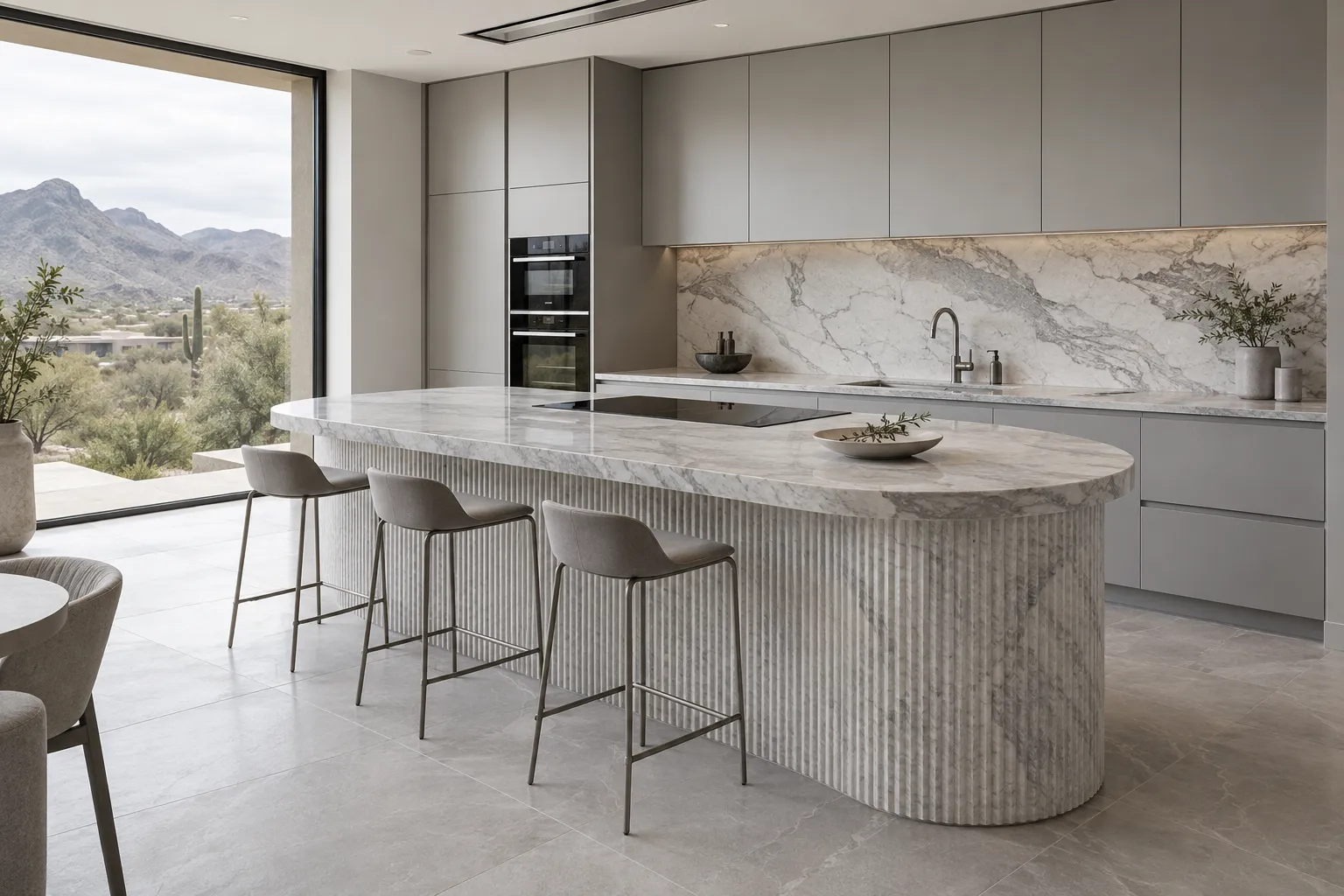
Both surfaces suit the valley, and the choice usually comes down to the kitchen rather than the climate. Kitchens with open plans often put the counters on display from the living room, so pattern consistency carries weight and quartz has an edge along a long visible run. In older kitchens where the counter is one element among many, there is more room for whatever slab catches your eye, and granite's one-of-a-kind pattern is part of the appeal. The published ranges for the two are close, so the deciding factors tend to be the look and the care routine you want to live with. Read the kitchen countertops page for the full spread of surfaces and the cost guide for the numbers.
074 questions
Questions people ask
Still have a question? Call (747) 243-2089 and describe the kitchen.
01Is quartz cheaper than granite?
Not at the averages, which are the same. Fixr lists quartz for 35 sq ft at $2,600 to $4,400, an average of $3,500, or $50 to $200+ per sq ft, and granite for 30 sq ft at $2,500 to $5,000, an average of $3,500, or $40 to $200 per sq ft for material. Published market ranges, not a quote. The actual price is set after an on-site assessment.
02Can I put a hot pan directly on the counter?
It is better not to. The Natural Stone Institute recommends coasters and trivets for stone surfaces, and makers of engineered slabs publish their own heat guidance. Use a trivet or a folded towel every time, and keep one within reach of the range. The habit costs nothing and protects the finish.
03How should I clean quartz and granite counters?
Match the cleaner to the surface. For calcareous natural stone, the Natural Stone Institute recommends mild non-acidic cleaners, because acids can dull or etch it. For quartz, follow the manufacturer's instructions. Blot wine, citrus and oils right away instead of wiping, which spreads them, and keep the care sheet the fabricator provides alongside your appliance manuals.
04What does countertop replacement cost in total?
Fixr lists kitchen countertop replacement at $1,400 to $5,250, an average of $3,000, and a national cost survey lists $1,882 to $4,484, an average of $3,161. The final number depends on the material, the edge profile, the sink cutout and the number of seams. Published market ranges, not a quote. The actual price is set after an on-site assessment.