Help guide · 6 min read
How to Keep Matte and Lacquer Cabinet Fronts Looking New in Arizona Sun and Dry Air
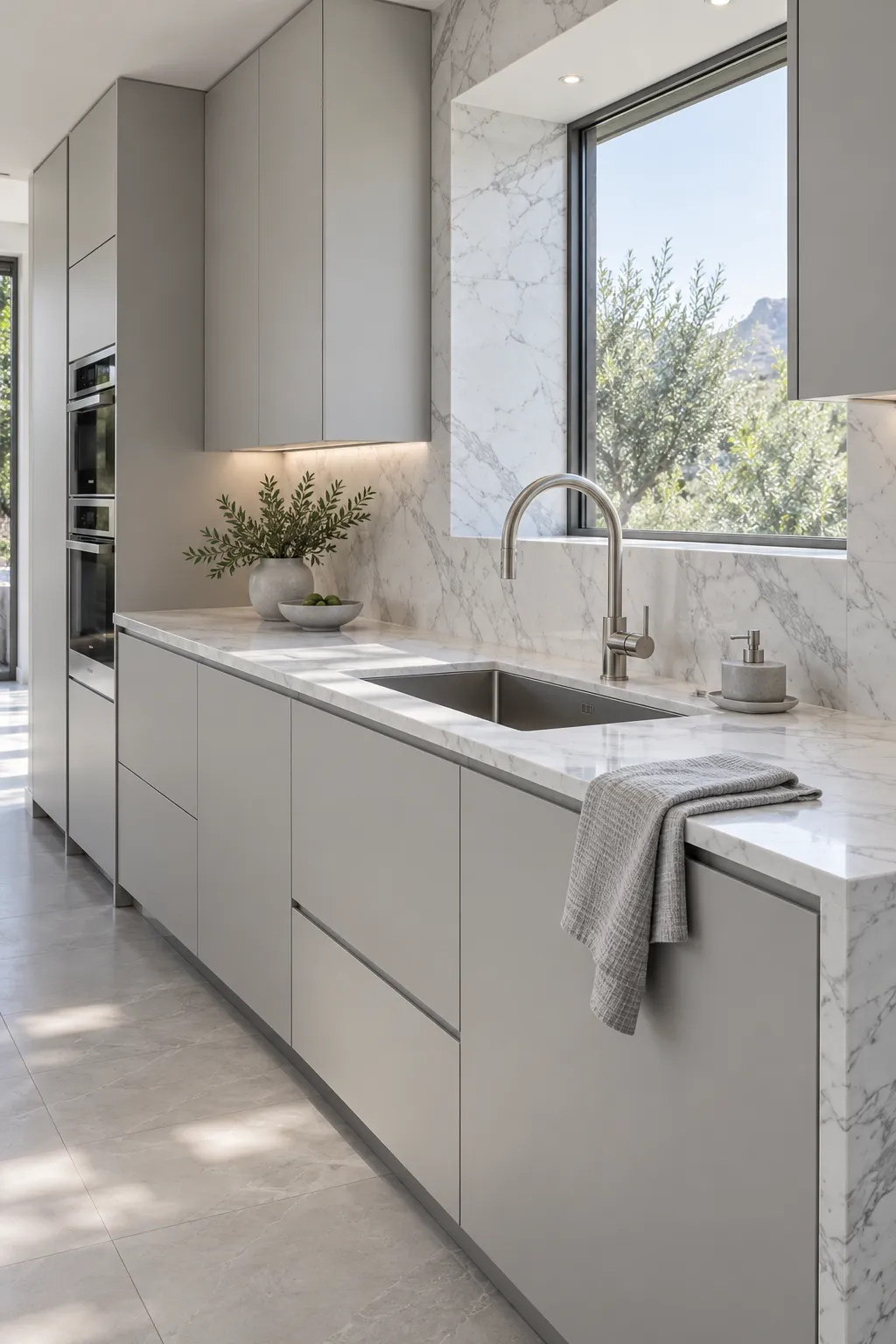
You keep matte and lacquer fronts looking new in Scottsdale with 3 habits: a pH neutral cleaner on a microfiber cloth, no scrubbing in one spot, and shade or a UV aware finish on the run that faces the sun. The finish does not fail from grease here. It fails from UV and from a sheen change where someone worked too hard on one mark. That is the part most care articles miss. They are written for a humid climate and a generic painted door, and they say things like use a damp cloth and avoid abrasives. True, and not enough for a house that gets 111 days a year at or above 100 F and a west window that pours light onto the same 6 doors every afternoon. A matte finish does not scratch so much as burnish. Scrub one patch and the sheen lifts slightly, and that patch cannot be polished back the way a gloss scratch can, because polishing a matte surface tends to make it glossier, not more matte. The second half is that "lacquer" describes 2 different products. A 1K lacquer and a 2K polyurethane can look identical on day one, and one finish maker notes that 2K systems are better at resisting yellowing.
01Good to know
What actually damages a lacquered front in Arizona
| Cause | What you see | Why it happens here | What to do |
|---|---|---|---|
| UV through glass | Yellowing or a colour shift on pale fronts | Hours of direct sun a day, year round | Shade the run, or specify a UV stable finish |
| Heat near the range | Gloss change, soft spots | A front 2 feet from a cooktop runs hot | Give the range breathing room, use the hood |
| Scrubbing one spot | A shiny patch | Matte sheen is directional, burnishing is permanent | Soft cloth, circular, whole door not the spot |
| Solvent cleaners | Dull or sticky areas | Alcohol, ammonia and citrus strip the top coat | pH neutral cleaner only |
| Abrasive pads | Fine scratches that hold dirt | Micro abrasion on a low sheen surface | No scrub pads, ever |
| Hard water spots | White rings and streaks | Scottsdale water is 16 to 25 gpg | Dry the front after cleaning |
| Dry air | Joint gaps, hairline cracks at seams | Winter indoor humidity drops to 15 to 25 percent | Control the joint design, not the humidity |
The dry air row is a build problem, not a cleaning one. Wood and MDF move with humidity, and a door built with no allowance shows a gap in February that it did not show in September.
02Good to know
Why the sheen is the thing you are protecting
A matte finish works by scattering light. Any change to the surface texture changes how it scatters, and the eye reads that as a patch. That is why the care routine is about touch, not chemicals: the wrong cloth with the right cleaner will still burnish a matte door.
Three rules:
- Microfiber, not paper towel. Paper towels and sponges are abrasive at this scale.
- Clean the whole door. Work the panel, not the smudge, so any change is even.
- Dry it. Water left on a front in this water is a mineral deposit waiting to happen.
03Good to know
How to clean a matte front without changing the sheen
Weekly: a microfiber cloth dampened with water and a drop of pH neutral dish soap, wrung out so it is barely damp. Wipe the whole front in one direction, then dry with a second clean cloth.
For a real mark: start with water. Then a diluted neutral cleaner. Then, only if needed, a cleaner the finish maker approves, tested on the inside of a door first. Never go straight to a specialty product, because the strongest product you use becomes the new baseline for the finish.
For grease near the range: a degreaser is the wrong tool on a lacquered front. Warm water and a neutral cleaner, more passes, less pressure. If the film has cured on, the finish may already be stained and no cleaner will bring it back.
For hard water: dry immediately. Acid and solvent are the 2 things a lacquered front does not forgive.
04Good to know
Which finish and which front fit your house
Fits: a matte lacquer front in a north or east facing kitchen, with a run away from the range, a household that keeps a microfiber cloth in a drawer, and a budget for a 2K polyurethane top coat on pale colours. One finish maker notes that 2K systems are better at resisting yellowing, and pale colours are where yellowing shows.
Skip it if: the entire run faces a west window with no shade, the kitchen is a rental, or the household reaches for a magic eraser. In those conditions, a laminate front or a wood veneer with a matte texture is the more honest choice, because it can take a scrub.
Fits: a walnut or oak front in a kitchen where hands land on the front every day, with a household that will re-oil or accept a patina. Black walnut is 1,010 lbf on the Janka scale, hard enough for daily contact, and the finish on it is what you are maintaining, not the wood.
Skip it if: the light in the room is harsh and the dust is constant. Dark matte shows every fingerprint and every dust film, and Scottsdale has dust. Light and mid tone greys are the forgiving choice.
054 steps
The sun is the first enemy, not the grease
Two local numbers explain why. Phoenix has averaged 111 days a year at 100 F or hotter since the 1990s, and the sun that comes through a west window in July is at eye level in the late afternoon, hitting the same cabinet run day after day. Pale lacquer takes that load first.
The practical fixes, in order of cost:
A shade or a solar screen on the glass that hits the run.
Moving the pale fronts off the sunlit wall and putting them on the interior run.
A finish system specified for UV, which is the 2K conversation, not the colour conversation.
Accepting the shift and designing with a colour that ages well, which is why warm greys and mid tones are safer than white.
The Italian kitchen guide covers the palette these fronts belong to. If the fronts are being replaced rather than cleaned, the cabinet page covers refacing, replacement and door styles, and the remodel guide has the 21 questions to settle first. The second local factor is water. Scottsdale runs 16 to 18 gpg north of Chaparral and 22 to 25 gpg south of Indian School Road, and mineral spots left to dry become a cleaning problem that tempts the scrub that burnishes the sheen.
06Planning
What decides the right routine for your kitchen
Four things decide it, and a contractor can read all 4 in one visit: which way the glass faces, how close the range sits, what the front is actually made of (a 2K lacquer, a 1K lacquer, a laminate or a veneer), and how the household cleans. The care plan follows from those, not from a generic checklist.
A local contractor checks the sun path at the hour the kitchen is used, the clearance at the range, and the finish specification on the door sample. Then the routine gets written for the actual kitchen.
Call (480) 672-2248 and describe the fronts and the light, or send the form, and someone from our team will call you back.
074 questions
Questions people ask about matte and lacquer fronts
Still have a question? Call (480) 672-2248 and describe the kitchen.
01Can a shiny patch be fixed?
Usually not in place. A burnished patch is a sheen change, and polishing makes it glossier. The fix is a respray of that door, or replacing the front, which is why prevention matters.
02Is matte harder to keep clean than gloss?
It hides fingerprints better and shows sheen changes more, and the margin for scrubbing is smaller.
03Does sun fade lacquer?
UV shifts colour and gloss, especially on pale and white fronts. A 2K system is made to resist yellowing, and shade helps more than any product.
04Can I use a magic eraser?
No. It is an abrasive melamine foam, and on a matte front it will leave a dull or shiny patch that does not blend.
08Sources
Sources
- 2K polyurethane colour and gloss retention
- Matte finish burnishing and care variation between matte products
- The Wood Database, Black Walnut (opens in a new tab)
- KJZZ, Phoenix days at 100 F (opens in a new tab)
- City of Scottsdale, Hard Water Facts (opens in a new tab)
- Desert winter indoor humidity range
Last checked: November 2026