Help guide · 9 min read
Italian-Style Kitchen Remodel in Scottsdale: Marble, Travertine and Walnut That Live Well in Desert Heat
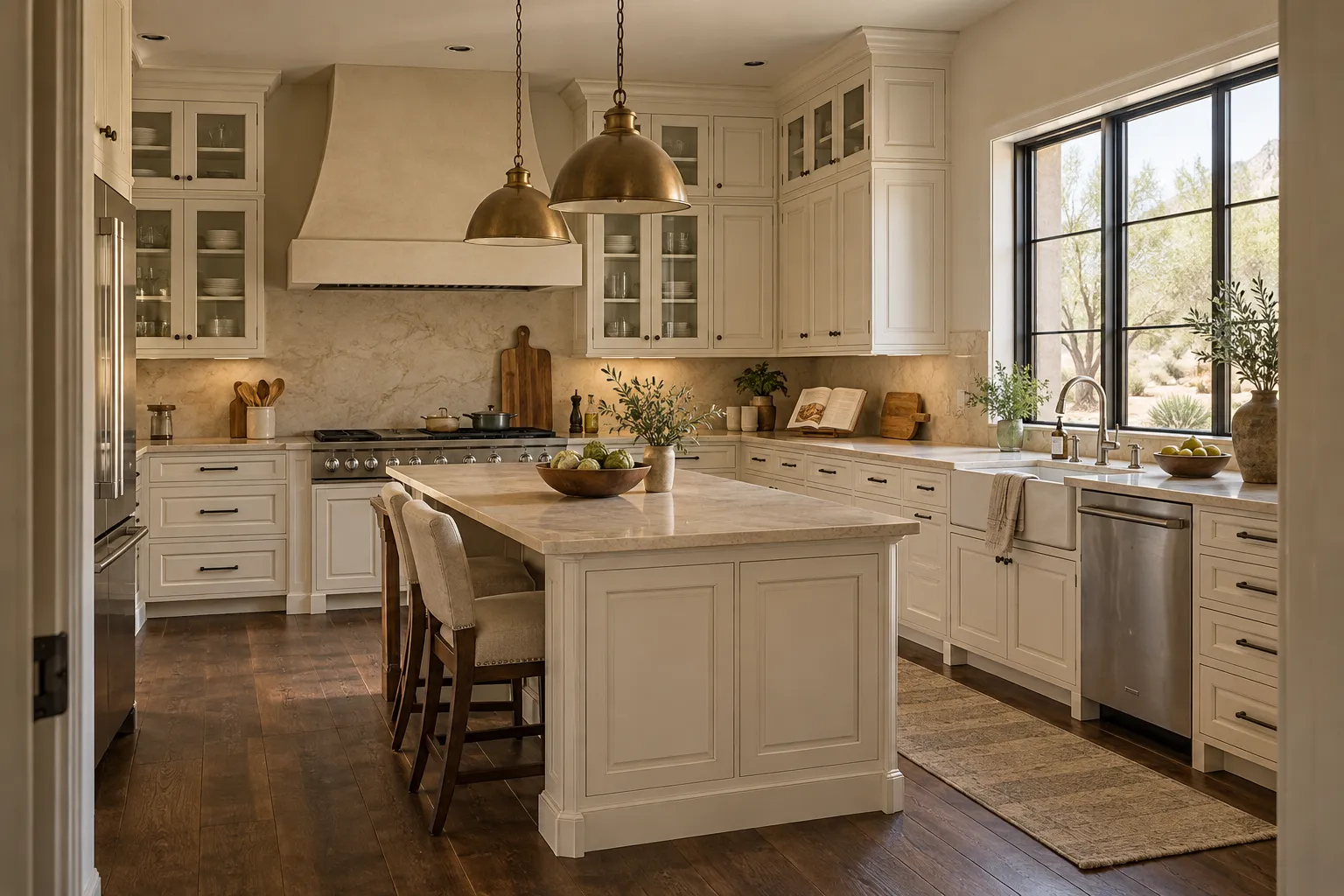
An Italian-style kitchen works in Scottsdale when the stone is chosen by where it sits, not by how the sample looks on a table. The look travels here without trouble; the material list has to change, because Scottsdale water runs 16 to 25 grains per gallon and Phoenix has averaged 111 days a year at or above 100 F since the 1990s. The rooms people save on Pinterest were specified for Milan, Como or the Ligurian coast. Mild summers, soft water, windows that face north over a courtyard. Drop that list into a 1990s Scottsdale house with a west wall of glass and a sink that sees the afternoon sun, and the same palette fails in 2 predictable places. The 2 places an Italian spec fails here are where the water lands and where the sun hits. Every choice below follows from those two.
01Good to know
What makes a kitchen look Italian rather than just expensive
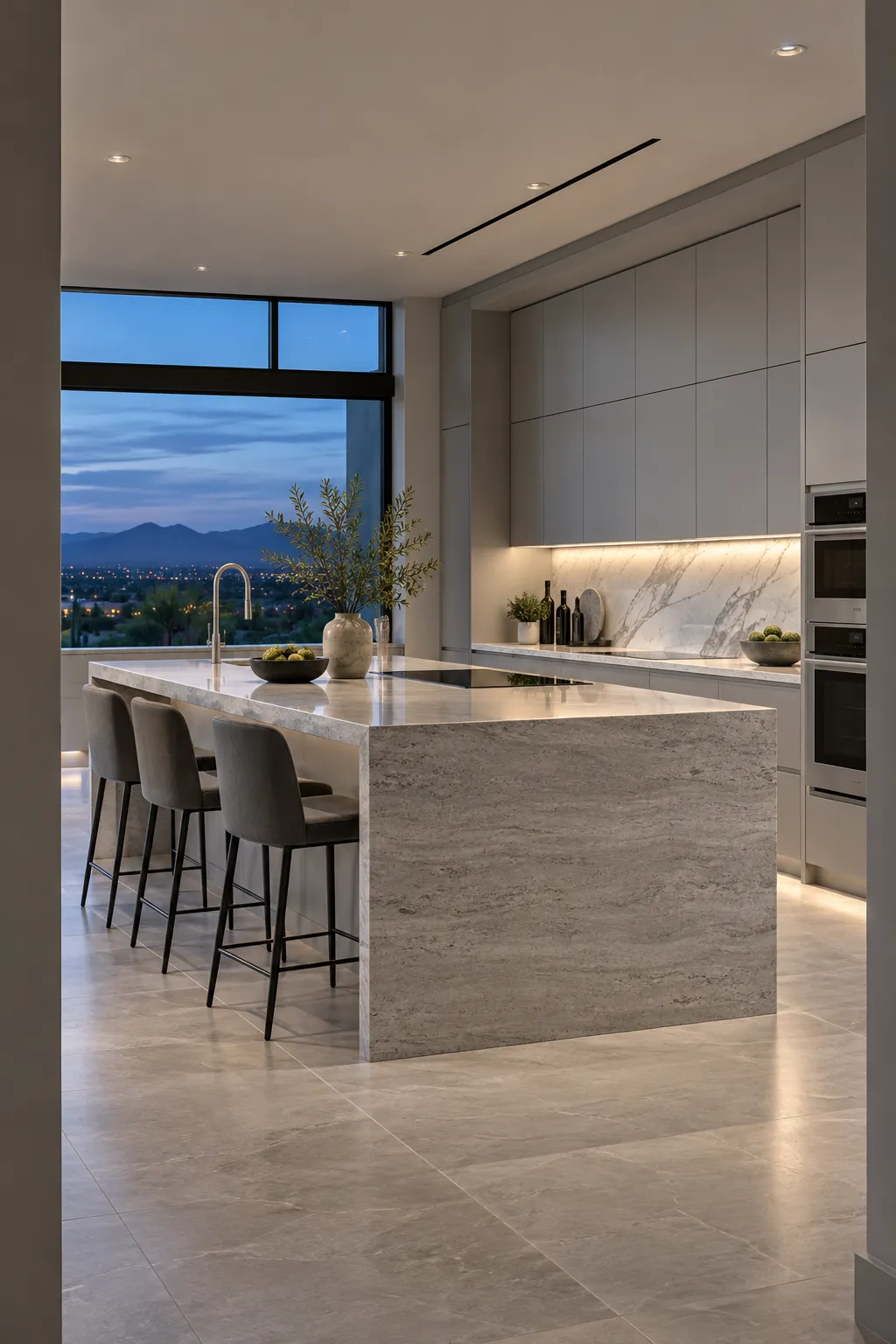
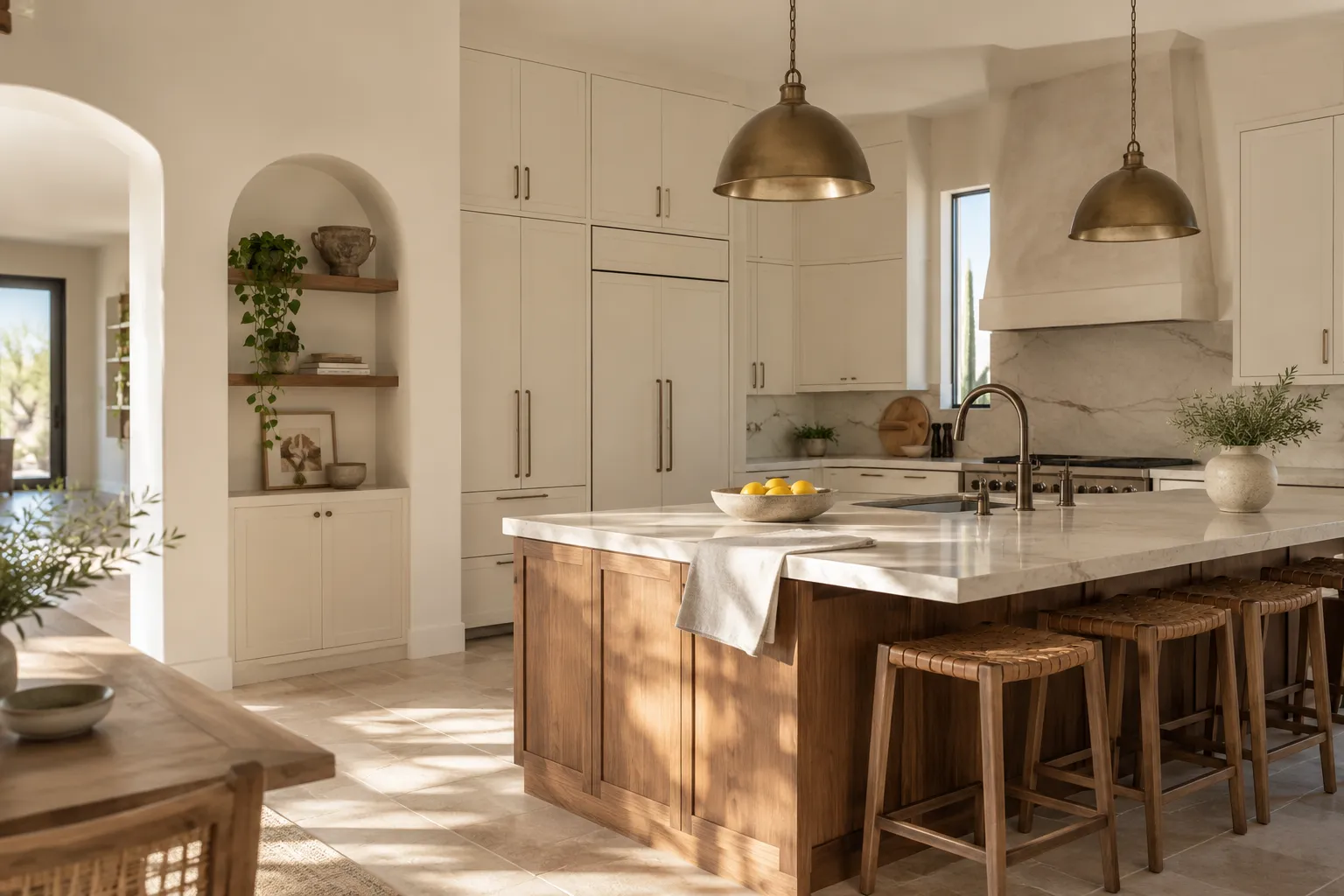
Italian kitchen design is about proportion and material honesty, not ornament. A run of plain doors in a warm grey, one slab of stone with real movement, walnut where hands touch, plaster or limewash on the wall, and almost no visible hardware. The room reads calm because 1 material is allowed to be dramatic and everything else supports it.
The 5 moves that do most of the work:
| Move | What it is | What it does for the room |
|---|---|---|
| One dramatic slab | A single stone with strong veining, used in one place | Gives the eye a place to land, so the rest can stay quiet |
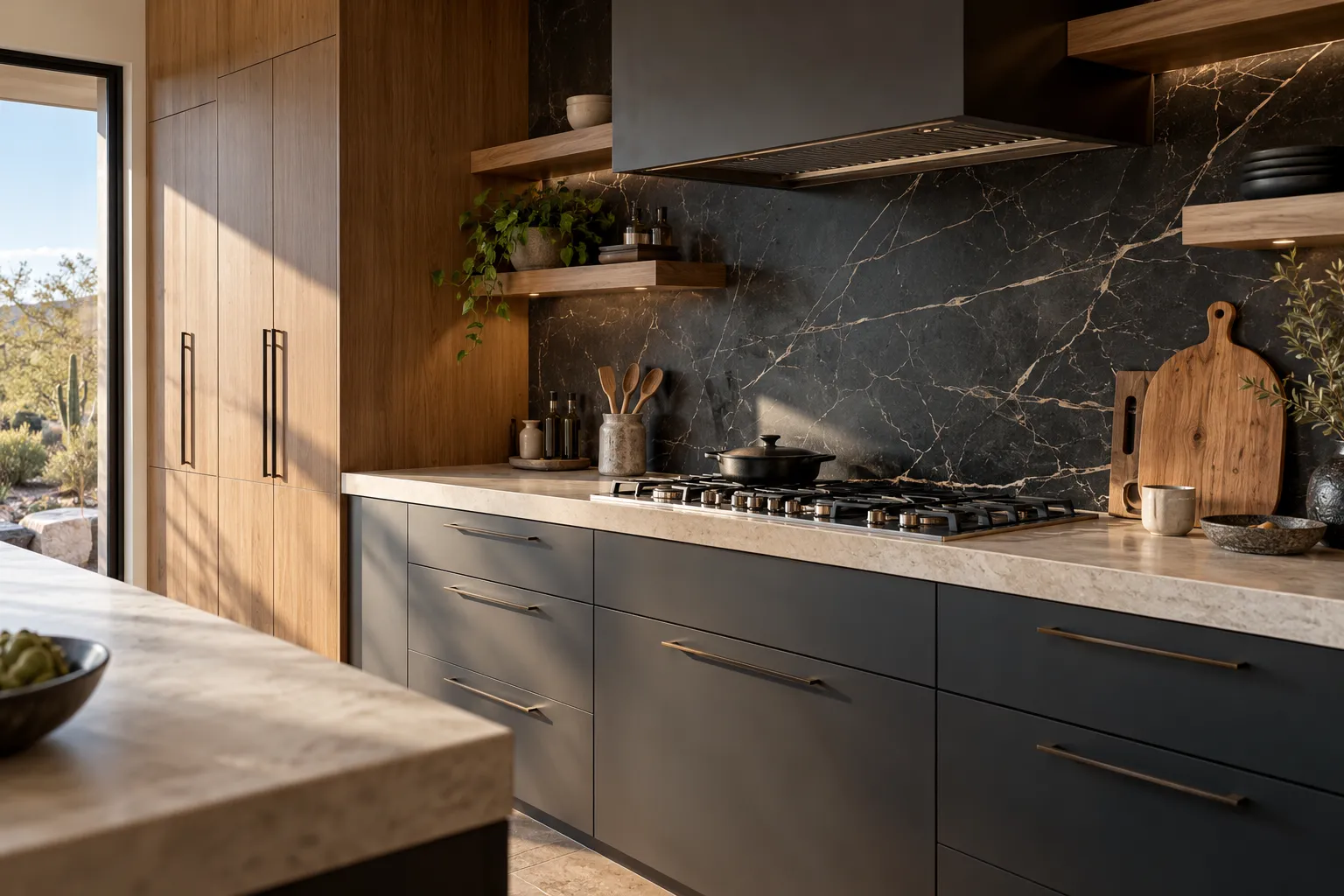
| Warm wood | Walnut or oak at the island, the shelves or the tall units | Cuts the cold of stone and grey, adds the Italian warmth |
| Matte fronts | Flat doors, low sheen, no visible pull | Keeps light soft, hides the cabinet line |
| Plaster or limewash | A hand finished wall, not drywall and paint | Softens the reflection that makes a desert room feel hard |
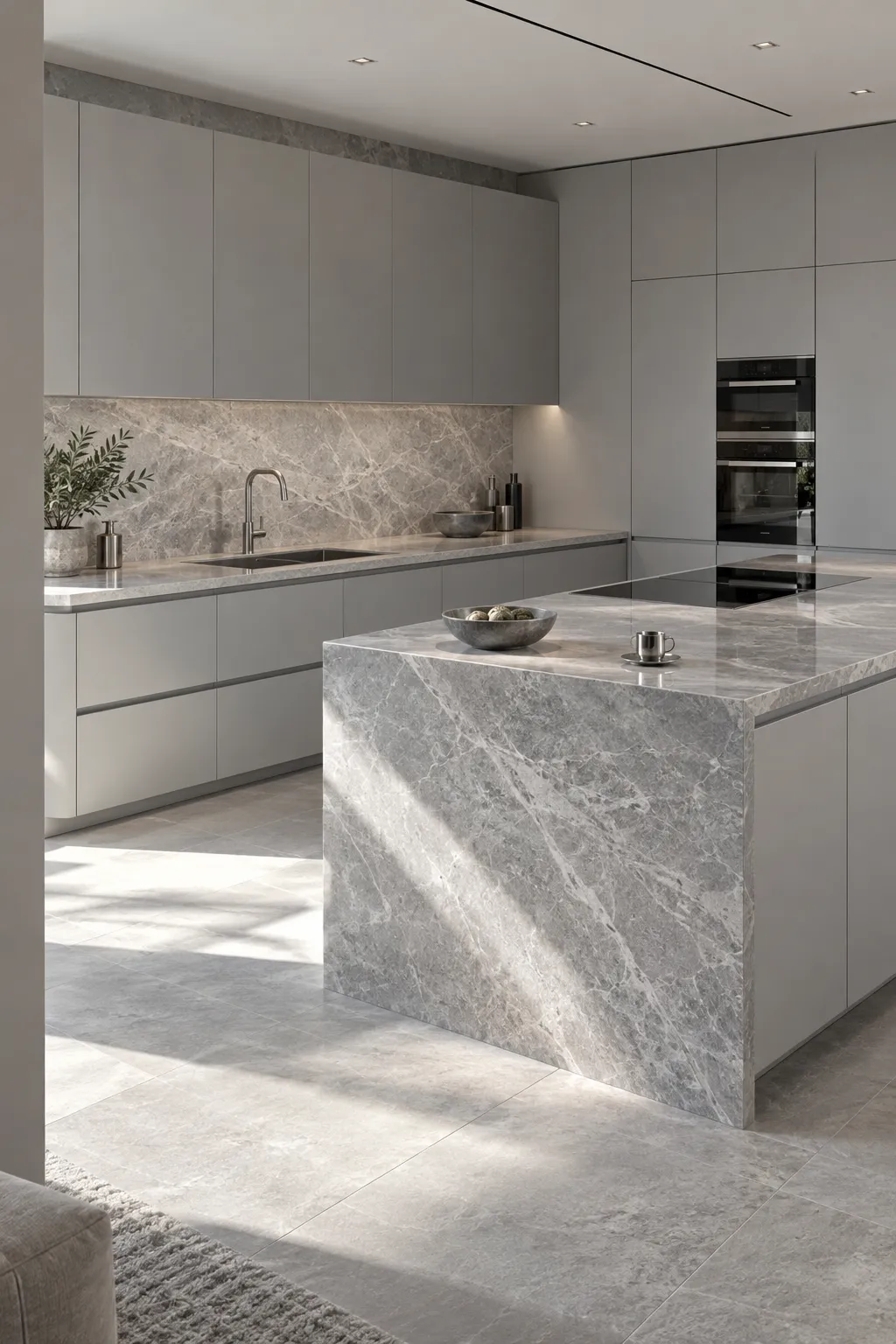
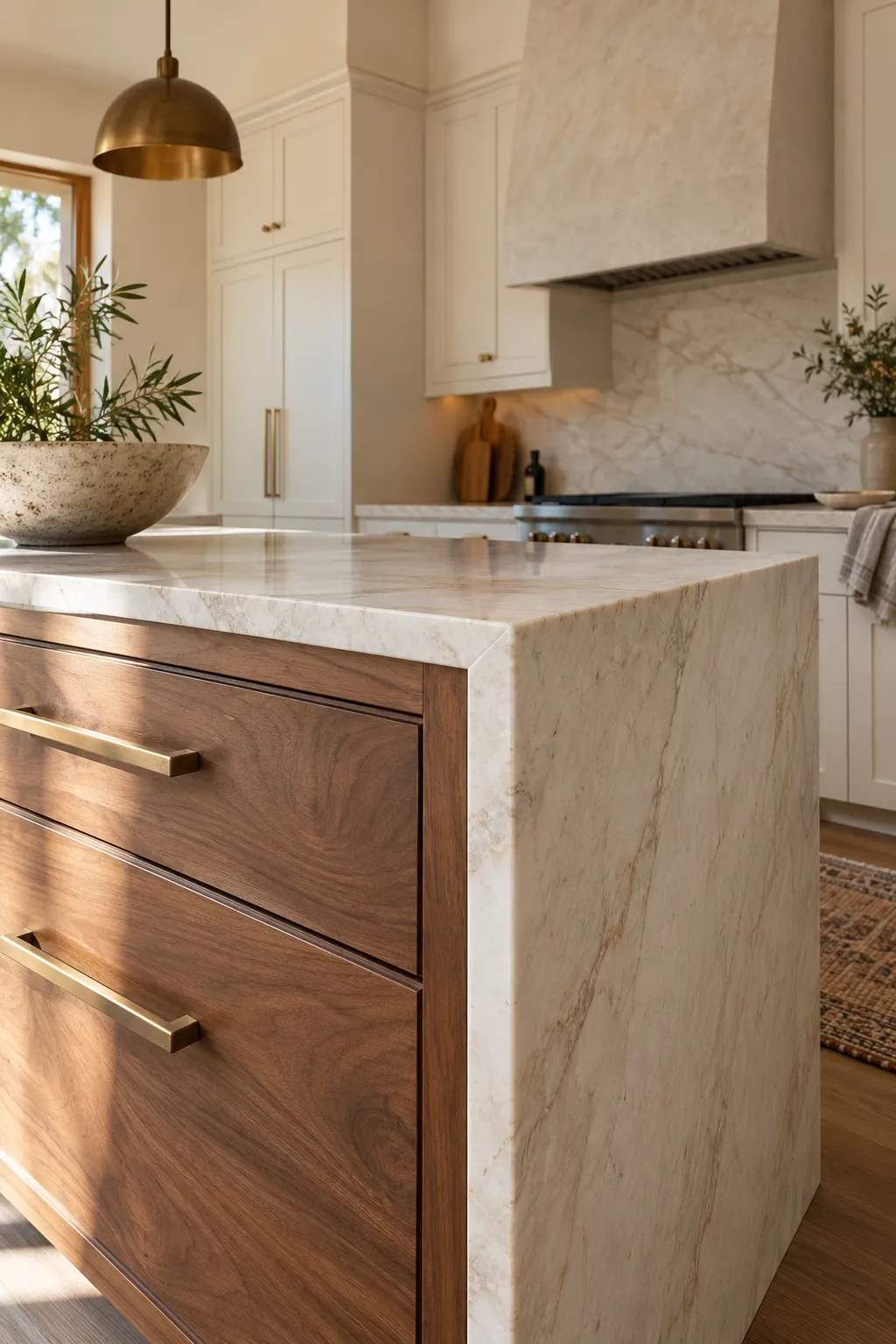
| Stone to the floor | A waterfall leg or a stone plinth | Makes the island read as a block, not a table |
None of that is expensive by default. The cost sits in the stone and in how precisely it is set.
02Countertops
Which stone belongs where in a Scottsdale kitchen
Assign the stone by plane, because each plane meets a different enemy. The island top meets knives, heat and glasses. The perimeter meets the sink, which is where water sits. The backsplash meets steam and splatter. The floor meets grit and chairs.
| Plane | Stone that works here | Why it works | What to avoid |
|---|---|---|---|
| Island top | Quartzite, or a dense dolomite | Quartzite is quartz at 7 on the Mohs scale and does not etch; dolomite is denser and less absorbent than marble | Polished white marble in the busiest spot |
| Perimeter and sink run | Honed dolomite or quartzite | Honed finishes hide etch and water spots better than polished | Travertine next to a tap without planning |
| Backsplash | Marble slab, bookmatched | It is vertical, so nothing sits on it and acid spills are rare | Marble behind the cooktop without a wipe habit |
| Floor | Porcelain that reads as stone, or filled travertine | Porcelain takes grit and chairs; filled travertine needs the voids handled | Unfilled travertine in a walkway |
| Island leg (waterfall) | Same slab as the top, from the same bundle | The leg and top must match at the miter | A second bundle bought later |
Read that table next to the waterfall island material comparison and the stone durability comparison before you fall in love with a slab. The miter, not the surface, decides whether a waterfall works. If the cabinets stay and only the surfaces change, start on the countertop page. If the layout moves too, the full remodel page covers the sequence and the permit question.
03Countertops
What Scottsdale water does to marble and travertine
Scottsdale water is hard, and how hard depends on your street. South of Indian School Road it runs 22 to 25 grains per gallon, between Indian School and Chaparral 20 to 22, and north of Chaparral 16 to 18, according to the city's own hard water fact sheet. That range matters because a glass of tap water left on a counter leaves calcium carbonate behind, and on a polished calcareous stone that ring is a dull spot.
Marble, travertine and limestone are calcium carbonate. The Natural Stone Institute puts it plainly: calcareous stone is sensitive to acidic solutions, and cleaners with lemon or vinegar may dull or etch it. Etching is not a stain. It is a change in the surface finish, and on a polished slab it shows as a lighter, duller patch that catches the light differently.
Travertine is the one people get wrong. It is a limestone, not a marble, and its voids come from gas trapped during formation. Those voids are filled with cement or resin at fabrication, and a void sitting just under the face can break through later under a point load. None of that disqualifies travertine. It means the specification has to say filled, honed, and not in the busiest walking line.
Sealing helps and is oversold. The products the trade calls sealers are impregnators. They repel, they do not seal, and the Institute is explicit that sealing does not make stone stain proof. A sealer buys you time on a spill. It does not stop acid, and it does not stop hard water spots.
04Materials
Does walnut work in desert air?
Walnut works, with a caveat about movement. Black walnut measures 1,010 lbf on the Janka scale, hard enough for drawer fronts and a table top that gets real use. The issue in Scottsdale is not hardness, it is the swing between a 110 F afternoon and a winter house running 15 to 25 percent indoor humidity. Wood moves when humidity moves, and a wide solid walnut panel moves more than a door.
What that means in practice:
- 01
Solid walnut on doors and drawers
fine, if the panel is floated in the frame and the finish seals all 6 sides.
- 02
Solid walnut on a wide island top
plan for movement, and do not butt it tight to stone.
- 03
Walnut veneer on a stable core
the calmer choice for tall flat fronts, because the core resists the swing.
- 04
Oiled walnut
beautiful, and a maintenance habit. It needs re-oiling, and water rings show until you do.
- 05
Lacquered walnut
more protection, less tactile. One finish maker notes that 2K systems are better at resisting yellowing.
Walnut that gaps at a joint in year 2 is usually a moisture content problem at fabrication, not a bad species. Ask what the stock was acclimated to.
05Lighting
Why matte and not gloss in this light
Matte fronts are the correct Italian choice here for a reason that has nothing to do with fashion. A desert kitchen gets hard light. Gloss sends it back at you, shows every finger and every dust film, and looks worse at 4 pm in July than it did in the showroom. Matte absorbs that light and keeps the room quiet.
The trade off is sheen. A matte finish does not scratch so much as burnish: scrub one patch hard and it goes slightly shinier than the rest, and that patch does not blend back. That is why the care routine is short and specific, and why the finish system matters more than the colour. One finish maker notes that 2K systems are better at resisting yellowing, and yellowing shows first on the wall that faces the sun. The full routine is on the matte and lacquer care page.
One more local note: the run beside a west window or a glass door takes UV for hours a day. Pale lacquers shift first. If the front has to be pale, put the pale run away from the glass, or plan on a finish with a UV package.
06Good to know
Which Italian palette fits your house
Fits: a 1990s or 2000s Scottsdale house with an open kitchen. A honed quartzite island with a waterfall leg, matte greige or warm grey fronts, walnut at the island only, and plaster on the one wall you see from the family room. The room already has light and volume, so the material does the talking.
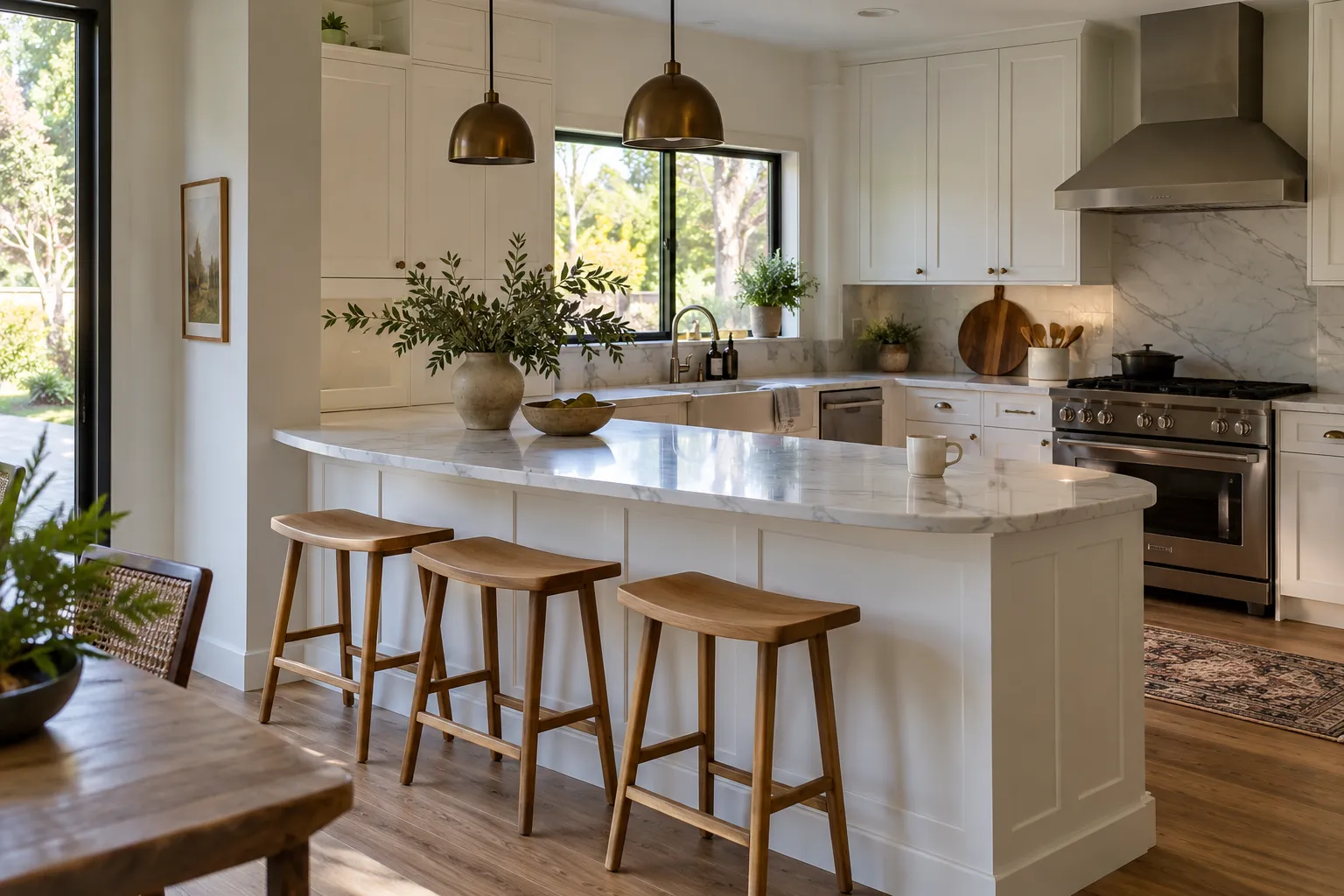
Fits: a mid-century or ranch house with a closed kitchen. A smaller stone budget, one bookmatched slab on the backsplash, flat panel doors in a warm white, oak rather than walnut, and a floor that reads as stone without the maintenance. Opening the room matters more than the slab, and the layout remodel page is where that decision starts.
Skip it if: the kitchen is a rental or a flip, the house has 10 years of deferred water damage behind the sink, or nobody in the house wants a stone care habit. Marble in a kitchen where nobody wipes is a 3 year regret.
Skip it if: the sink run is where the family lands every glass and every lemon. Put the marble where it can be admired and the dolomite where it gets used.
077 steps
How do you keep the look after year 1
A short routine keeps an Italian kitchen looking specified rather than tired:
Coasters under anything with citrus or alcohol, on every stone surface.
Trivets under hot pans, including the ones straight from the oven.
pH neutral cleaner, diluted, then rinse and dry
No vinegar, no lemon, no abrasive cream.
Blot a spill, do not wipe it across the slab.
Buff hard water rings with dry 0000 steel wool on stone, and keep the tap area dry.
Re-seal on the schedule the fabricator gives you, not on a calendar guess.
On matte fronts, microfiber and a neutral cleaner, and never a scrub pad on one spot.
08Planning
What decides the right combination in your kitchen
Three things decide it, and none of them can be read off a photo. Which way the glass faces, because that sets the UV load on the fronts and the stone. Where the water lands, because that sets which stone can take the sink run. And what is behind the wall, because that decides whether the layout you want is a finish change or a structural one.
A local contractor checks all 3 on site: the sun path through the windows at the hour you actually cook, the wall and floor with a level, and the plumbing and wiring behind the run you want to move. Then the stone and the fronts get specified around what the room can actually hold.
Call (480) 672-2248 and describe the room, or send the form, and someone from our team will call you back.
095 questions
Questions people ask about Italian kitchens in Scottsdale
Still have a question? Call (480) 672-2248 and describe the kitchen.
01Is Italian style the same as modern?
Not the same. Modern is a set of minimal moves. Italian style uses the same restraint but leans on warm materials, stone with movement and visible craftsmanship. A handleless grey kitchen can be either one, depending on the stone and the wood.
02Does marble always etch?
Polished marble etches from acid, and lemon, wine, vinegar and many cleaners all count. Honed marble shows an etch far less because the finish is already matte. It still happens; it is just less visible.
03Can travertine go on a countertop?
Yes, if it is filled and the variety is dense enough. The Institute notes that absorption across limestone and travertine ranges from under 1 percent to over 10 percent, and that range is why some travertine is a counter and some is a floor.
04Does a waterfall island work on a slab floor?
Yes. The leg sits on the slab like a plinth, and the floor meets it with a small movement gap. What matters is that the slab is flat where the leg lands, and that the miter is planned before the cabinet order.
05How hard is Scottsdale water, really?
Between 16 and 25 grains per gallon depending on the area, per the city. For comparison, water above 10.5 grains per gallon is classified as very hard.
10Sources
Sources
- Natural Stone Institute, Care and Cleaning of Natural Stone (opens in a new tab)
- Natural Stone Institute, Stain Removal and Etch Marks (opens in a new tab)
- Natural Stone Institute, Travertine, Limestone and Dolomitic Limestone (opens in a new tab)
- Natural Stone Institute, Travertine Voids (opens in a new tab)
- City of Scottsdale, Hard Water Facts (opens in a new tab)
- The Wood Database, Black Walnut (opens in a new tab)
- US Natural Stone, The Definitive Guide to Quartzite (opens in a new tab)
- KJZZ, Phoenix days at 100 F (opens in a new tab)
- USGS, water hardness classification (opens in a new tab)
- 2K polyurethane colour retention
Last checked: November 2026