Help guide · 6 min read
Which Natural Stone Countertop Lasts Longest in a Scottsdale Kitchen: Marble, Travertine, Quartzite or Dolomite
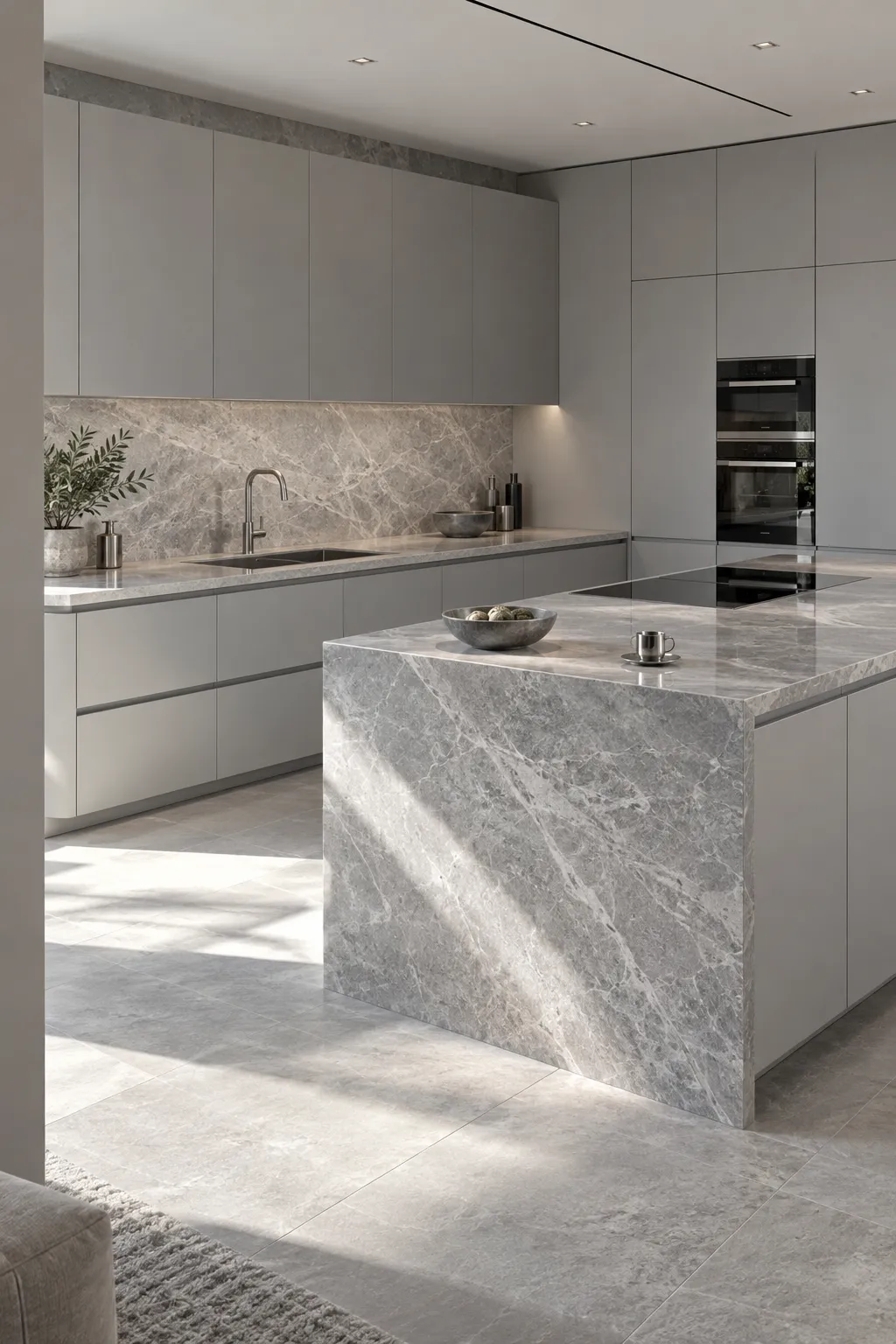
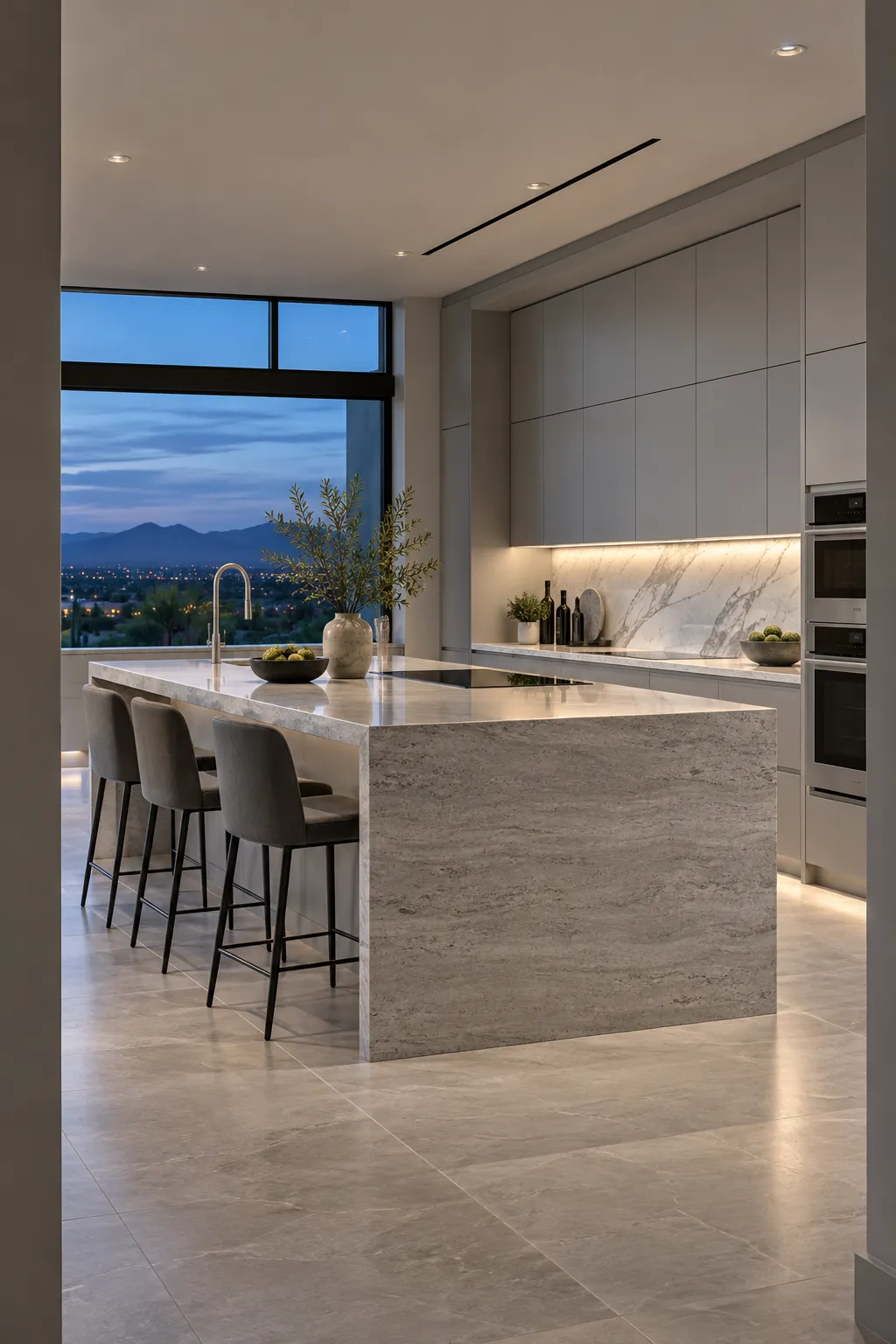
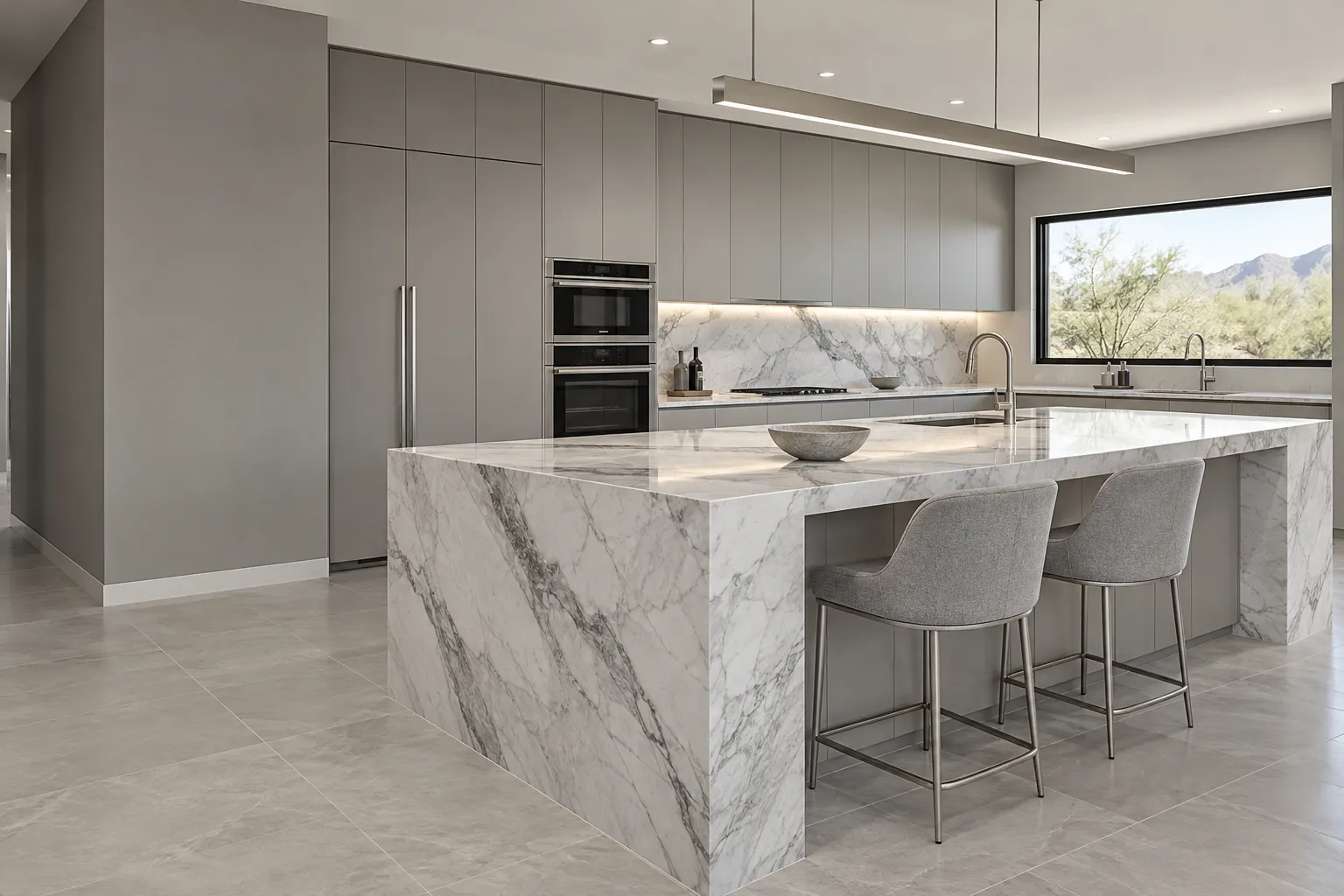
Quartzite holds up best of the 4 in a Scottsdale kitchen, because it is quartz at 7 on the Mohs scale, it does not etch, and it takes the heat that comes with a desert kitchen. Dolomite is a close second for a softer look, and marble and travertine are the 2 that need a care habit, because both are calcium carbonate and both react to acid. The ranking is not the interesting part. The interesting part is that many slabs sold as quartzite in Scottsdale are not quartzite, and a buyer comparing 4 stones may be comparing 2. In this valley, hard water is the stone problem people forget. Scottsdale water runs 16 to 25 grains per gallon depending on the street, and a sweating glass can leave calcium carbonate on the surface. On a polished calcite stone that becomes a dull ring. Separately, the word on the slab tag is not a test: real quartzite scratches glass and shrugs off vinegar, and a stone that etches with lemon was never quartzite.
01Countertops
The 4 stones ranked on the same criteria
| Criteria | Marble | Travertine | Quartzite | Dolomite |
|---|---|---|---|---|
| What it is | Metamorphosed limestone, calcium carbonate | A limestone with natural voids | Metamorphic rock made almost entirely of quartz | Calcium-magnesium carbonate, a denser limestone |
| Hardness | Soft, around 3 on Mohs | Soft, similar to marble | 7 on Mohs, harder than glass | Harder and more abrasion resistant than marble |
| Acid and etch | Etches from lemon, wine, vinegar | Etches, and the filled voids are a second weak point | Does not etch | Can etch, so test the slab |
| Hard water | Spots and dulls a polish | Spots, and minerals settle into voids | Spots sit on top, easy to remove | Spots, less absorption than marble |
| Absorption | Moderate to high depending on variety | Under 1 percent to over 10 percent across the family | Low | Lower than calcite limestone |
| Sealing | Recommended, and it does not stop etching | Recommended, especially on filled faces | Recommended | Recommended |
| Heat | Tolerates heat, thermal shock can crack | Tolerates heat | Tolerates heat | Tolerates heat |
| Best finish here | Honed, not polished | Honed and filled | Honed or polished | Honed |
Two footnotes to that table. First, "sealing" does not mean a coating. The stone trade uses impregnators that repel liquid, and the Natural Stone Institute is explicit that sealing does not make stone stain proof. Second, heat tolerance is not a licence to put a pan straight off the burner on any stone. Thermal shock, from a cold wet cloth on hot stone, can crack all 4.
023 steps
Quartzite: the one that wins, if it is real
Fits: the main prep run, the island, a busy family kitchen, a house with a west window. It gives you natural movement and acid resistance in the same slab.
Skip it if: the budget only covers one slab and you cannot reject a fissured one. A waterfall or a long run needs a slab you have actually inspected.
The label problem: the term soft quartzite exists because stone that is not quartzite is sold as quartzite. Quartzite is commonly mislabeled, and marble or dolomitic marble is sometimes sold under the name. Real quartzite is quartz. Soft stone labeled quartzite is marble.
How to check a slab in 60 seconds:
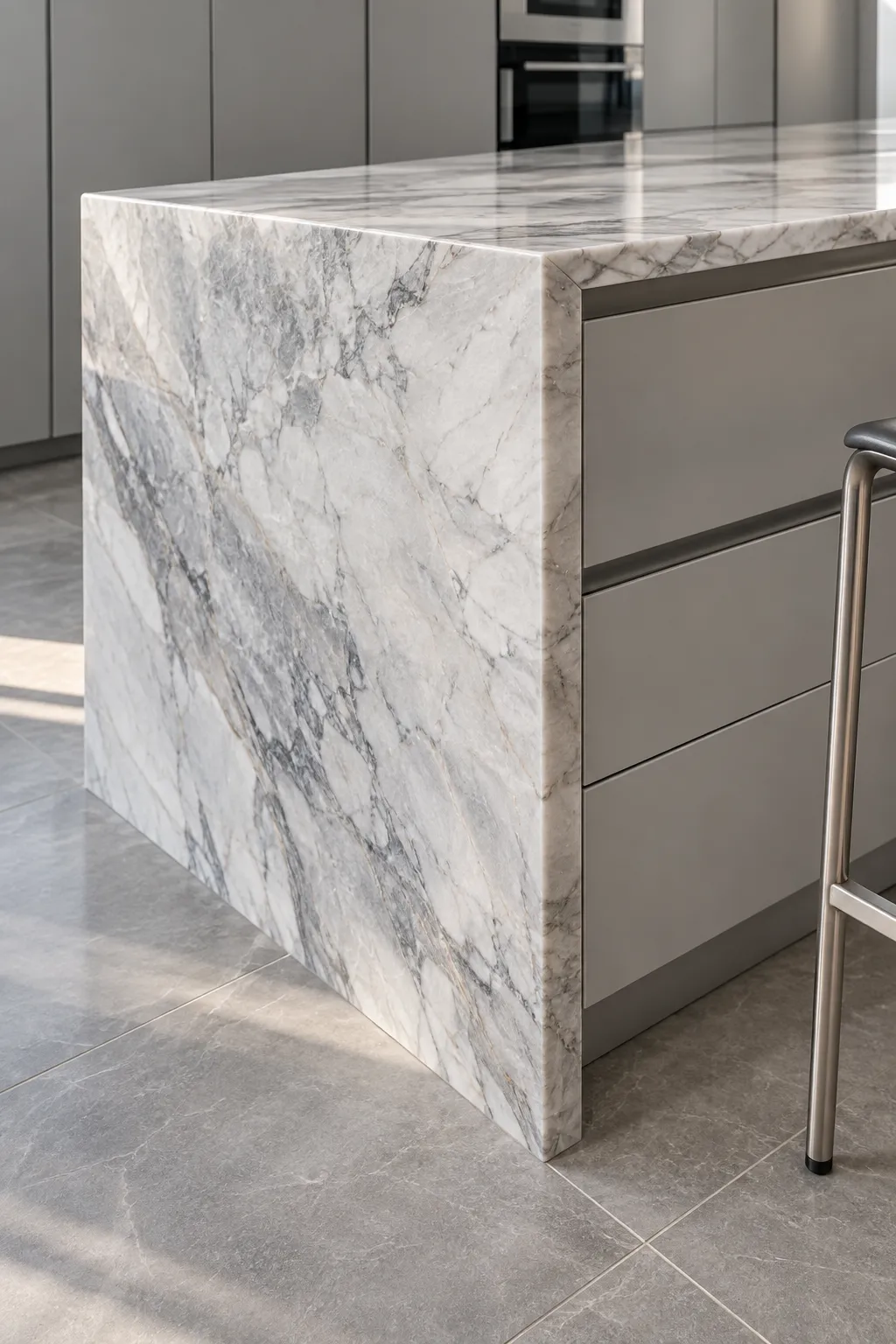
Ask for an offcut and put a drop of vinegar on it
Bubbling or a dull mark means calcite.
Try to scratch a glass jar with a corner of the offcut
Quartz at 7 scratches glass; calcite does not.
Look at the invoice and the slab tag
The geological name, not the trade name, is what you are buying.
03Good to know
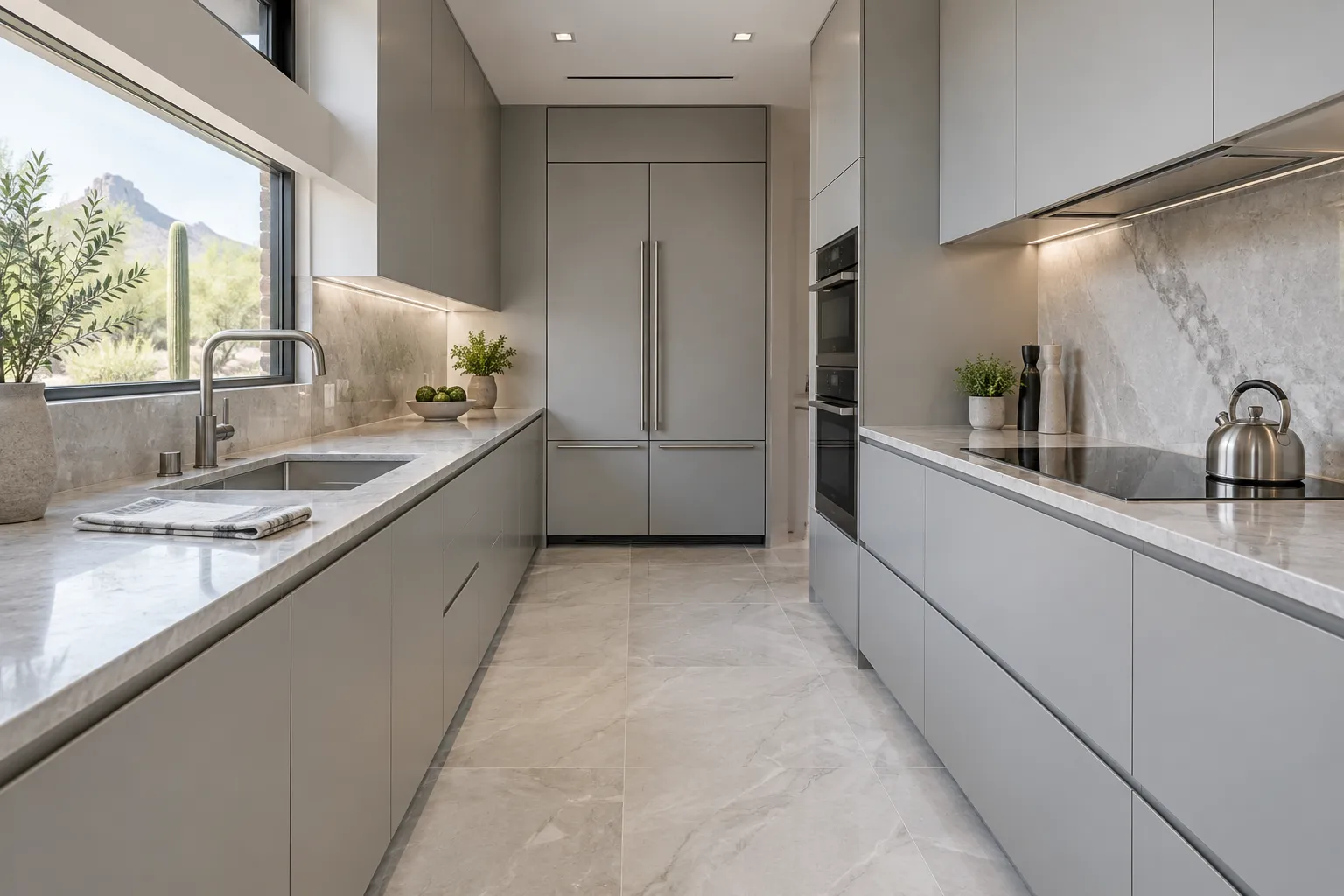
Dolomite: the underrated middle
Fits: a homeowner who wants the look of marble with better behaviour. The Institute notes that dolomites generally have higher densities, lower absorption, greater compressive and bending strength and higher abrasion resistance than calcium carbonate limestones, which is why they show up in applications where other limestones are marginal.
Skip it if: you expect it to behave like quartzite. It is still acid sensitive, just slower. A lemon left overnight will still mark it.
The honest version: dolomite is a denser, tougher limestone, not a different family. Buy it for the look and the slightly better manners, not for a promise that it will never etch.
04Countertops
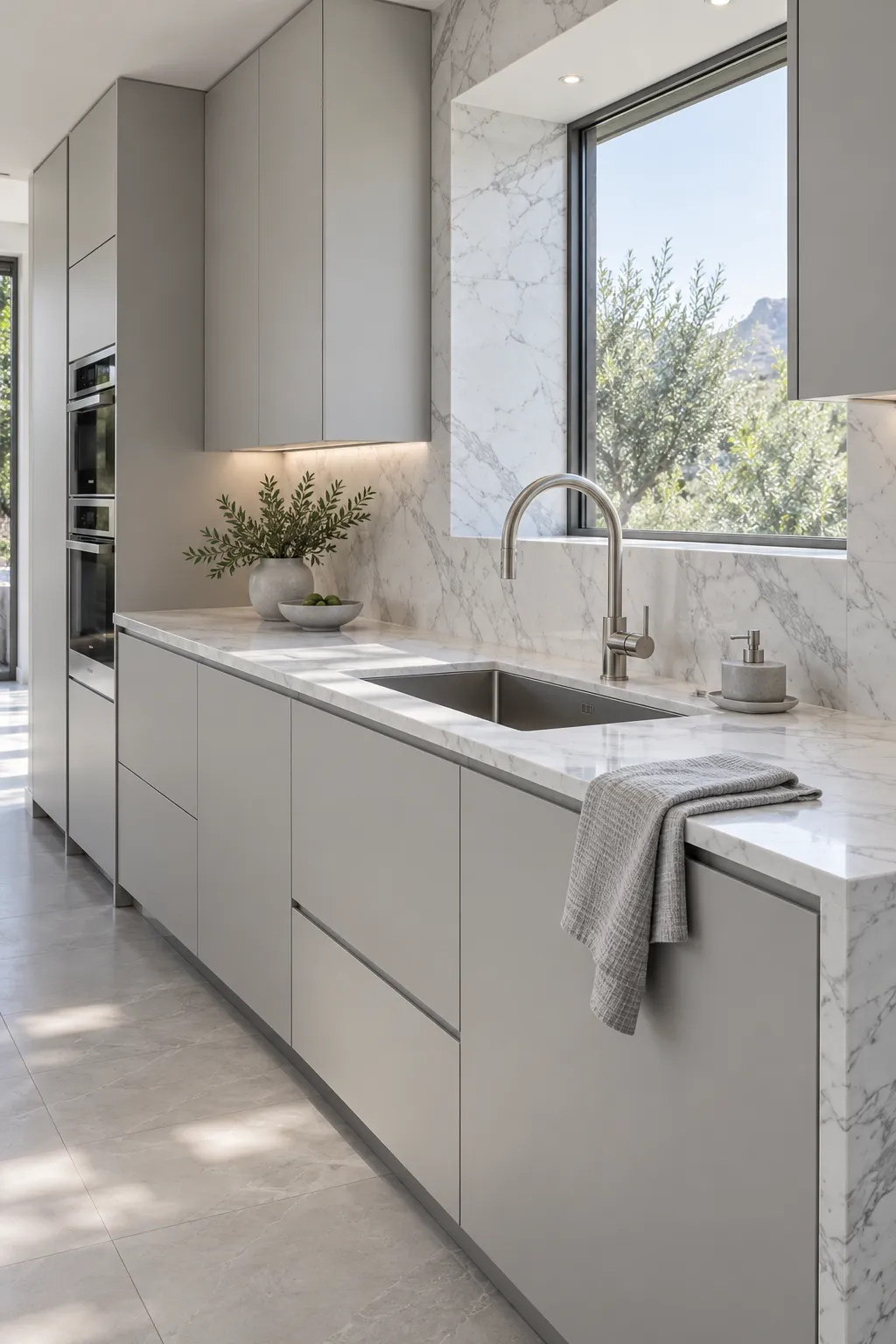
Marble: the one that asks something of you
Fits: a formal kitchen, a butler's pantry, a backsplash, a bathroom. Honed marble hides etch better than polished, and a honed finish is the right call in a working kitchen.
Skip it if: the counter is the family landing zone, or nobody wants to wipe and dry after every glass.
What actually happens: etching is a change in the finish, not a stain, so it does not come out with a cleaner. It comes out with a re-polish or a re-hone. A polished marble counter in daily use will develop a patina. Some people love that. Some people hate it. Decide before you buy.
05Materials
Travertine: beautiful, and the most misunderstood
Fits: a backsplash, a low traffic counter, a bathroom, a floor where the voids are filled and the traffic is planned.
Skip it if: it will sit next to a sink or a cooktop without a care plan. Travertine is a limestone, and its voids are structural. The Institute explains that voids come from trapped gas during formation, that they are filled with cementitious or resinous filler at fabrication, and that voids just under the face can break through later under a point load.
The countertop caveat: the Institute also notes that acid sensitivity plus absorption, which ranges from under 1 percent to over 10 percent across limestone and travertine, limits the varieties suitable for countertops. Translated: some travertine is a counter, some is a floor, and the difference is in the variety and the fill.
06Good to know
Which finish hides real life better
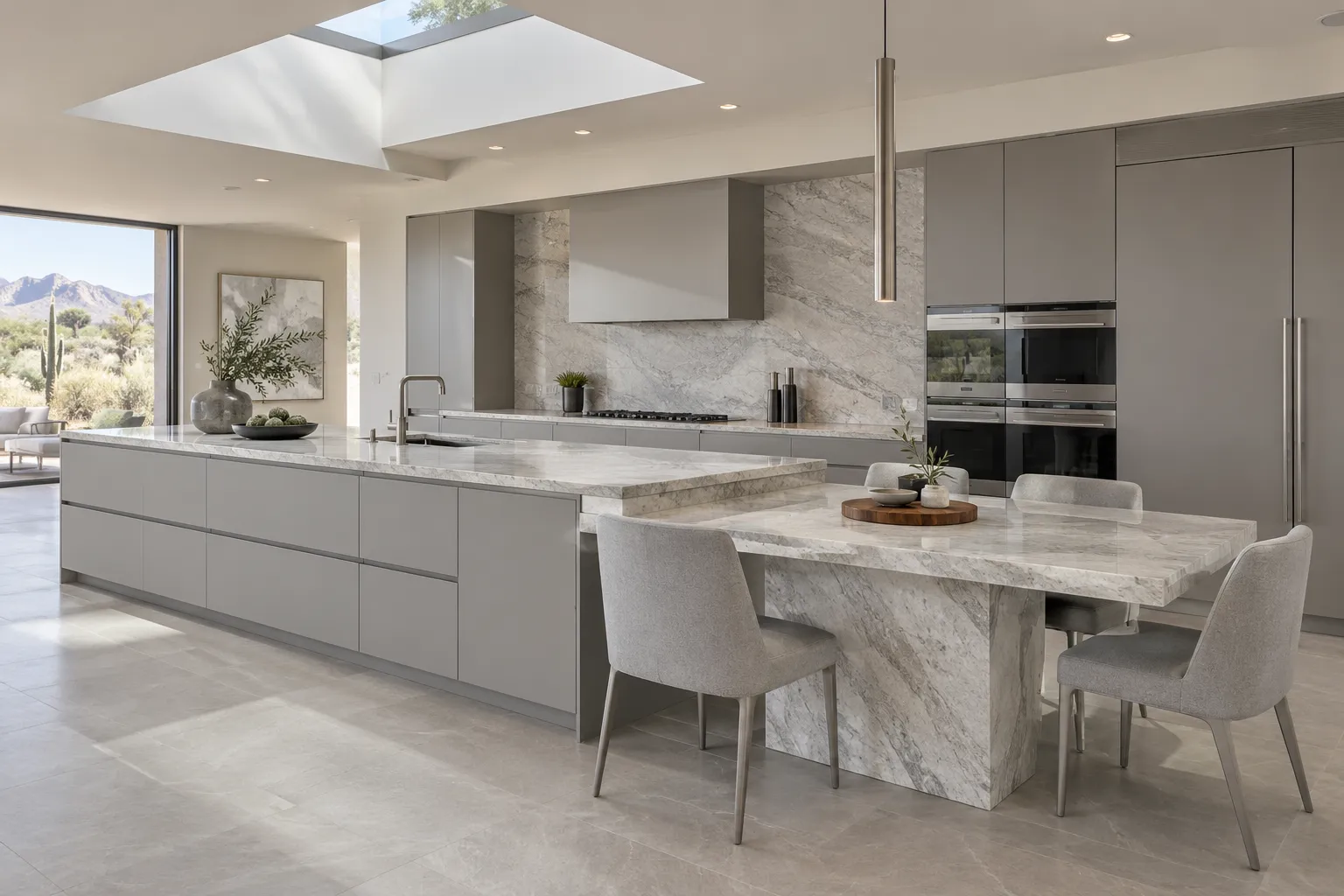
Honed wins in a Scottsdale kitchen. A honed surface scatters light, so an etch, a water spot and a fine scratch are all less visible. Polished shows every one of them, and it is the finish that hard water attacks most visibly.
The trade off is that honed surfaces need more cleaning, because the same texture that hides marks also holds them. The stone care rule stays the same: pH neutral, diluted, rinse, dry. The countertop page covers edges, templating and installation for each surface, the Italian kitchen guide shows where each stone belongs in the room, and the quartzite vs quartz blog covers heat and sun.
07Countertops
What decides the right stone in your house
Three on site checks decide it. Where the water lands, because the sink run and the tap splash zone are the hardest working square feet in the kitchen. Which finish the light supports, because a polished slab under a west window will show every mark by 4 pm. And what the slab actually is, because the tag and the invoice have to agree with the vinegar test.
A local contractor checks all 3 with you: the tap and sink layout, the light at the hour you cook, and the slab before it is cut. The stone then gets specified around the room it goes in.
Call (480) 672-2248 and describe the counter you want, or send the form, and someone from our team will call you back.
085 questions
Questions people ask about natural stone
Still have a question? Call (480) 672-2248 and describe the kitchen.
01Is dolomite the same as marble?
No. Dolomite is calcium-magnesium carbonate, denser and less absorbent than calcite marble, and it etches more slowly. It is still acid sensitive.
02Does quartzite stain?
It resists acid, but it is not stain proof. Oil and pigment can sit in a porous or honed surface, and sealing helps. What quartzite does not do is etch.
03How often do you reseal?
Follow the fabricator's schedule for the specific stone and sealer, and test with a water drop: if water darkens the stone instead of beading, it is due.
04Can an etch be polished out?
Yes, by a stone professional, and the result depends on the finish. A honed surface blends back more easily than a polished one.
05Is travertine safe near a sink?
Only with a filled, denser variety and a wipe habit. The sink run is where water sits longest.
09Sources
Sources
- Natural Stone Institute, Care and Cleaning of Natural Stone (opens in a new tab)
- Natural Stone Institute, Stain Removal and Etch Marks (opens in a new tab)
- Natural Stone Institute, Travertine, Limestone and Dolomitic Limestone (opens in a new tab)
- Natural Stone Institute, Travertine Voids (opens in a new tab)
- US Natural Stone, The Definitive Guide to Quartzite (opens in a new tab)
- City of Scottsdale, Hard Water Facts (opens in a new tab)
- KJZZ, Phoenix days at 100 F (opens in a new tab)
- USGS, water hardness classification (opens in a new tab)
- Stonify, marble and dolomitic marble comparison
Last checked: November 2026