Help guide · 6 min read
Best Materials for a Waterfall Island in Scottsdale
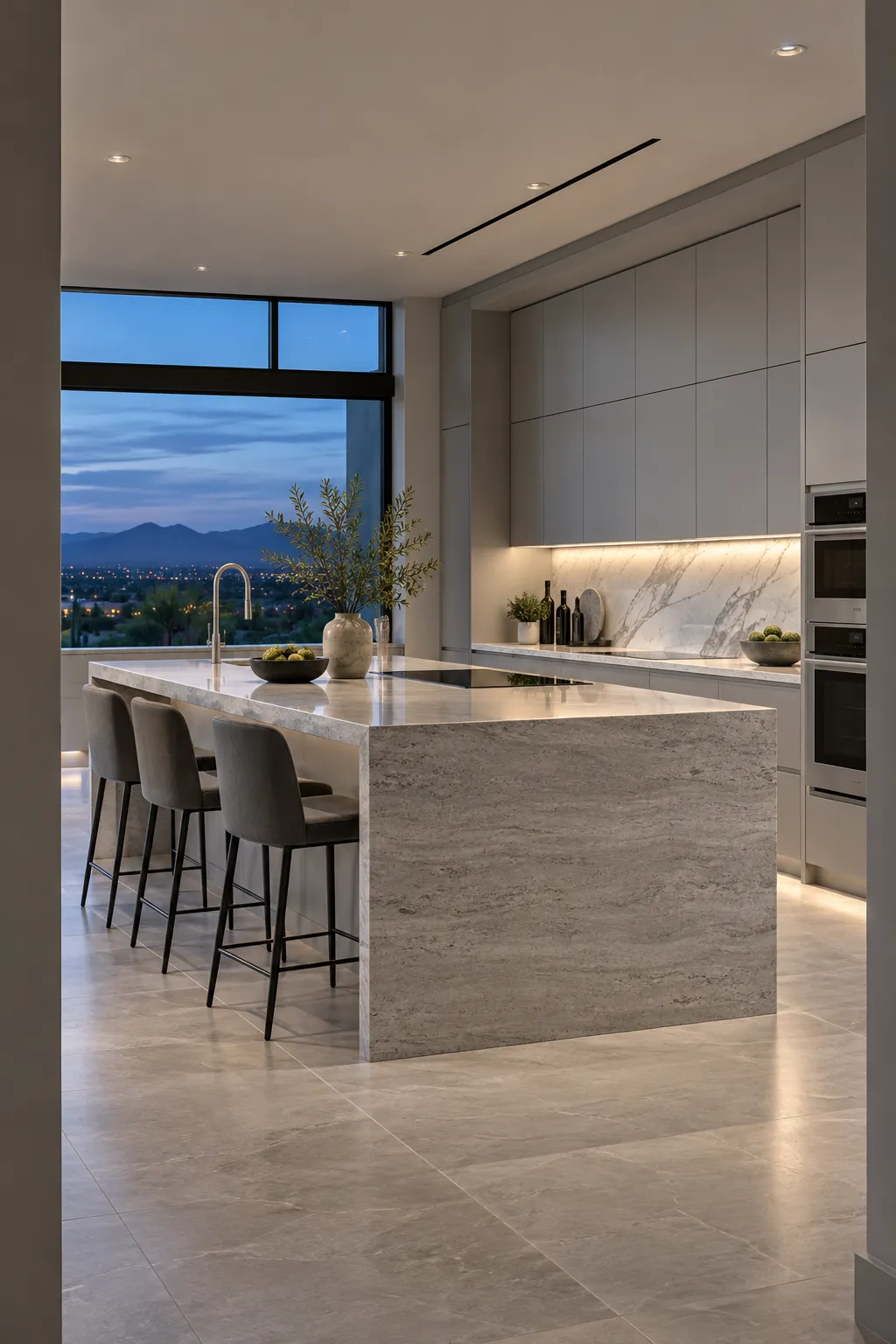
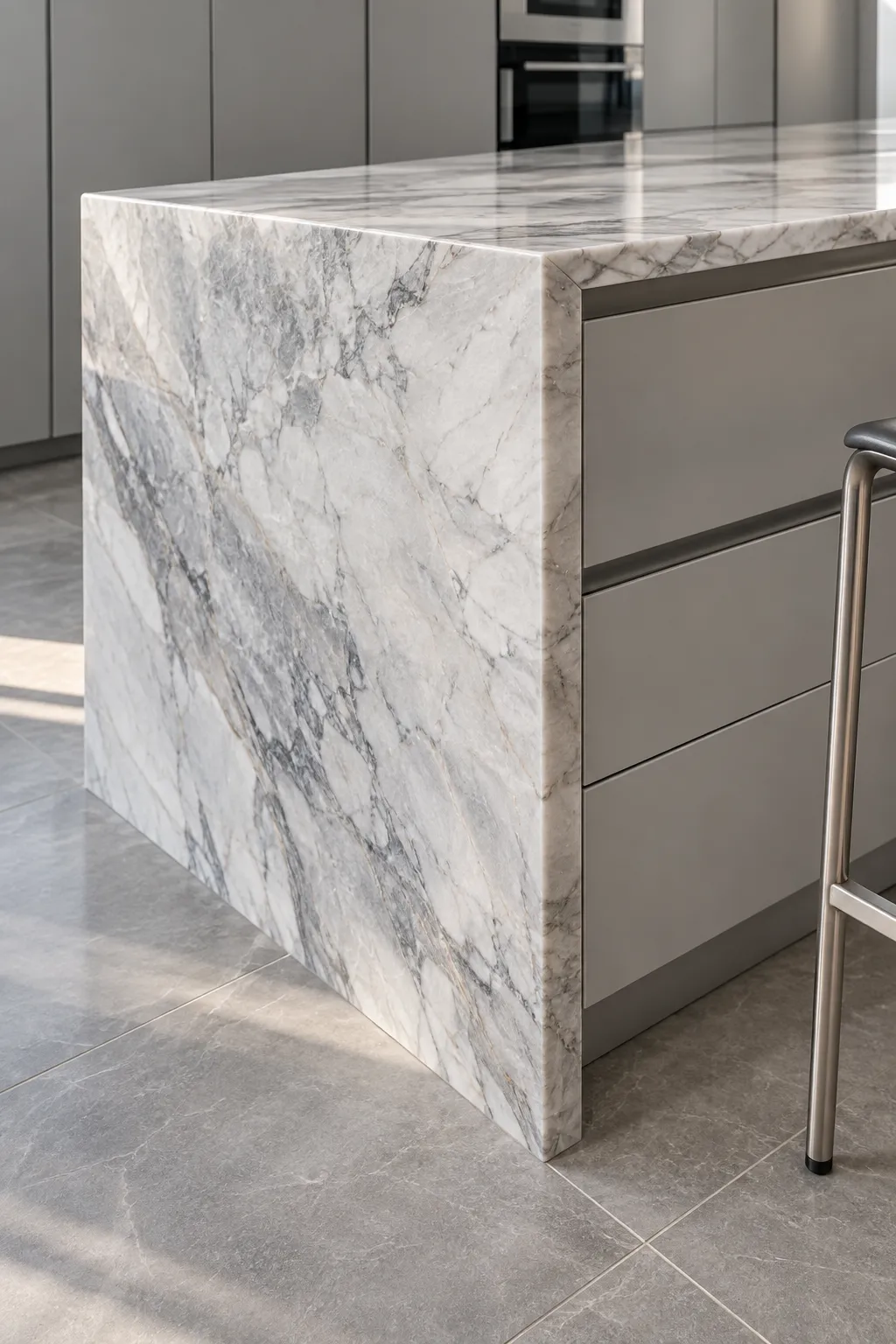
The best material for a waterfall island in Scottsdale is quartzite, because it takes the miter, shrugs off the sun that lands on a west facing leg, and does not etch from the lemon someone will eventually cut on it. Sintered stone and porcelain slab come next for a clean modern leg, marble wins on looks and loses on maintenance, and quartz is the practical choice only where the island never sees direct sun. The material is not decided by how the top looks. It is decided by the miter. A waterfall edge is a 45 degree joint where the horizontal top turns down into a vertical leg, and that joint is cut, polished and glued. A slab with fissures cannot hold a tight miter. A 12 mm porcelain slab has to be built up at the edge to read as 3 cm. A bookmatched pair must come from one bundle, or the legs will not match the top. And the most visible seam on the island sits at the outside corner, in the walkway, where every hand lands.
01Materials
Why the miter decides the material
The fabricator cuts each end of the top at 45 degrees, polishes both faces of the cut, bonds them with epoxy and colour matched filler, and clamps until cured.
- Fissures and voids disqualify a slab at the miter. A hairline fissure at the wrong spot will open at the joint, so the slab is inspected before it is bought.
- Thickness and veining are planned together. A 3 cm slab gives more material at the corner than a 2 cm slab, and top and legs are laid out from one bundle before any cut.
The leg also carries the overhang and takes every kick, so it has to sit on a flat slab or the joint opens.
02Materials
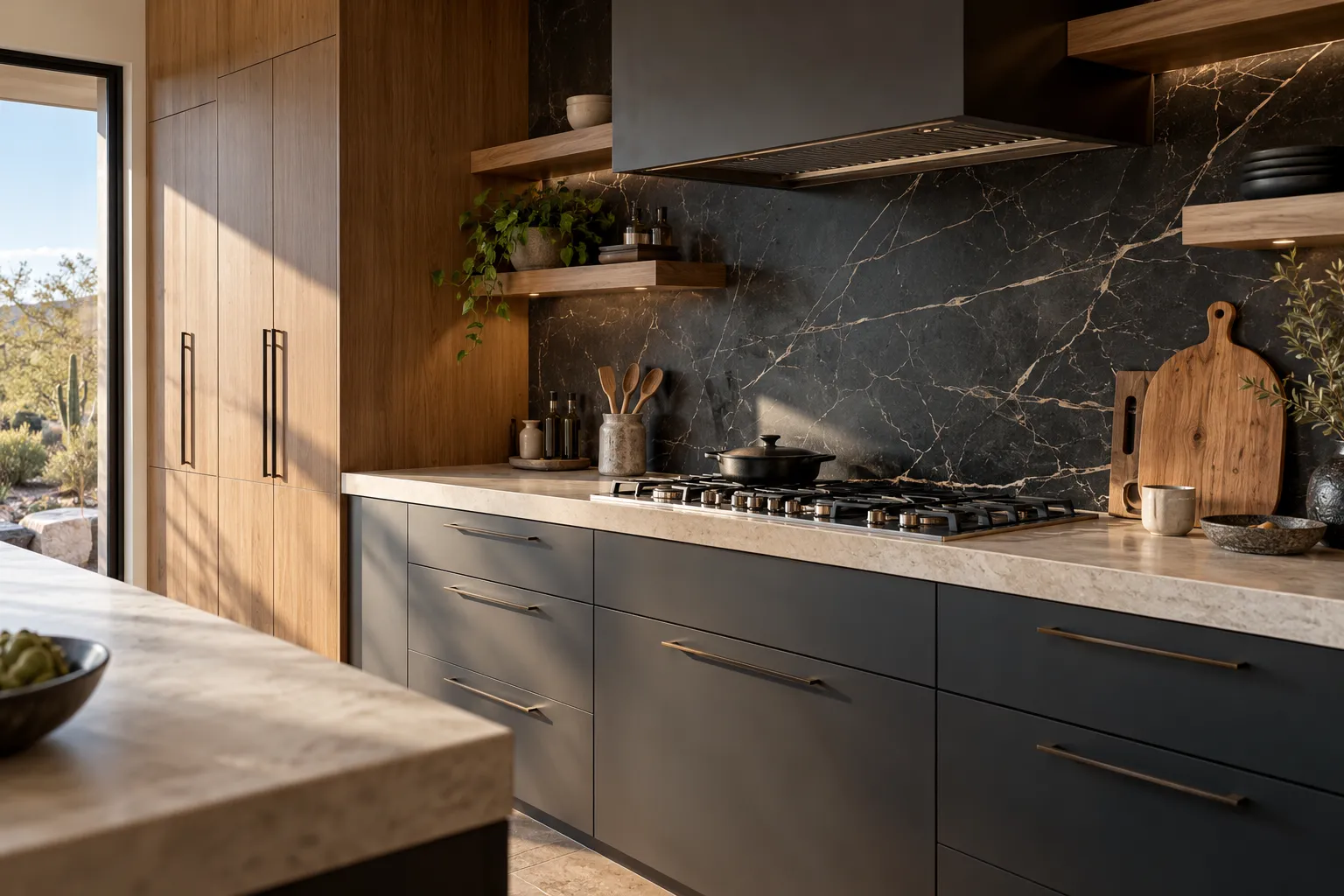
The 5 materials, compared on the same criteria
| Criteria | Marble | Quartzite | Porcelain slab | Sintered stone | Quartz |
|---|---|---|---|---|---|
| Look | Strongest natural movement, classic | Natural movement, harder to read | Printed stone look, very even | Printed look, tight and consistent | Even, repeatable |
| Acid and etch | Etches from lemon, wine, vinegar | Does not etch | Does not etch | Does not etch | Resists acid, but not strong chemicals |
| Heat | Tolerates heat, thermal shock can crack | Tolerates heat | Rated heat resistant | Rated for high heat and UV | Resin scorches, trivets required |
| The miter | Beautiful, fragile at fissures | Best balance of look and strength | Needs an edge build up at 12 mm | Clean miter, very consistent | Clean miter, very tight seams |
| Seams and matching | Visible, one of a kind | Visible, needs 2 slabs from one bundle | Minimal, repeatable pattern | Almost invisible | Tight and consistent |
| Care | Sealing, pH neutral cleaner | Sealing recommended | No sealing | No sealing | Nonporous, use high and low pH cleaners with caution |
| Weight and handling | Heavy | Heaviest | Light | Light | Heavy |
| Cost direction | High and slab dependent | High | Moderate | Moderate to high | Lowest of the 5 |
Slab price can double between bundles, and a waterfall uses more slab than a flat top because the legs come from the same material.
03Countertops
Quartzite: the default for a Scottsdale waterfall
What it is: a metamorphic rock made almost entirely of quartz. Real quartzite is 7 on the Mohs scale, harder than glass and a knife blade, and it does not etch from kitchen acids.
Fits: the island in a house where the family actually cooks, and any leg that faces west. It is the only natural stone here that combines real movement with acid resistance.
Skip it if: the budget cannot take rejecting a fissured slab, or the floor cannot take the weight.
The Arizona note: the name is a trap. Stone sold as soft quartzite is usually marble or dolomitic marble, and it will etch. Test with a drop of vinegar on an offcut and a scratch with a glass edge. Real quartzite should pass both.
04Countertops
Marble: the best looking leg, and the one that ages
What it is: a metamorphosed limestone, calcium carbonate, softer than quartzite and sensitive to acid.
Fits: a formal island in a room where the island is a showpiece and the prep happens on the perimeter. Honed marble hides etch better than polished.
Skip it if: the island is the family prep zone, or nobody wants to wipe and dry a counter every day.
The Arizona note: polish plus Scottsdale hard water is the hard combination. A glass left overnight can leave a ring that needs repolishing.
05Good to know
Porcelain slab: the 12 mm trick
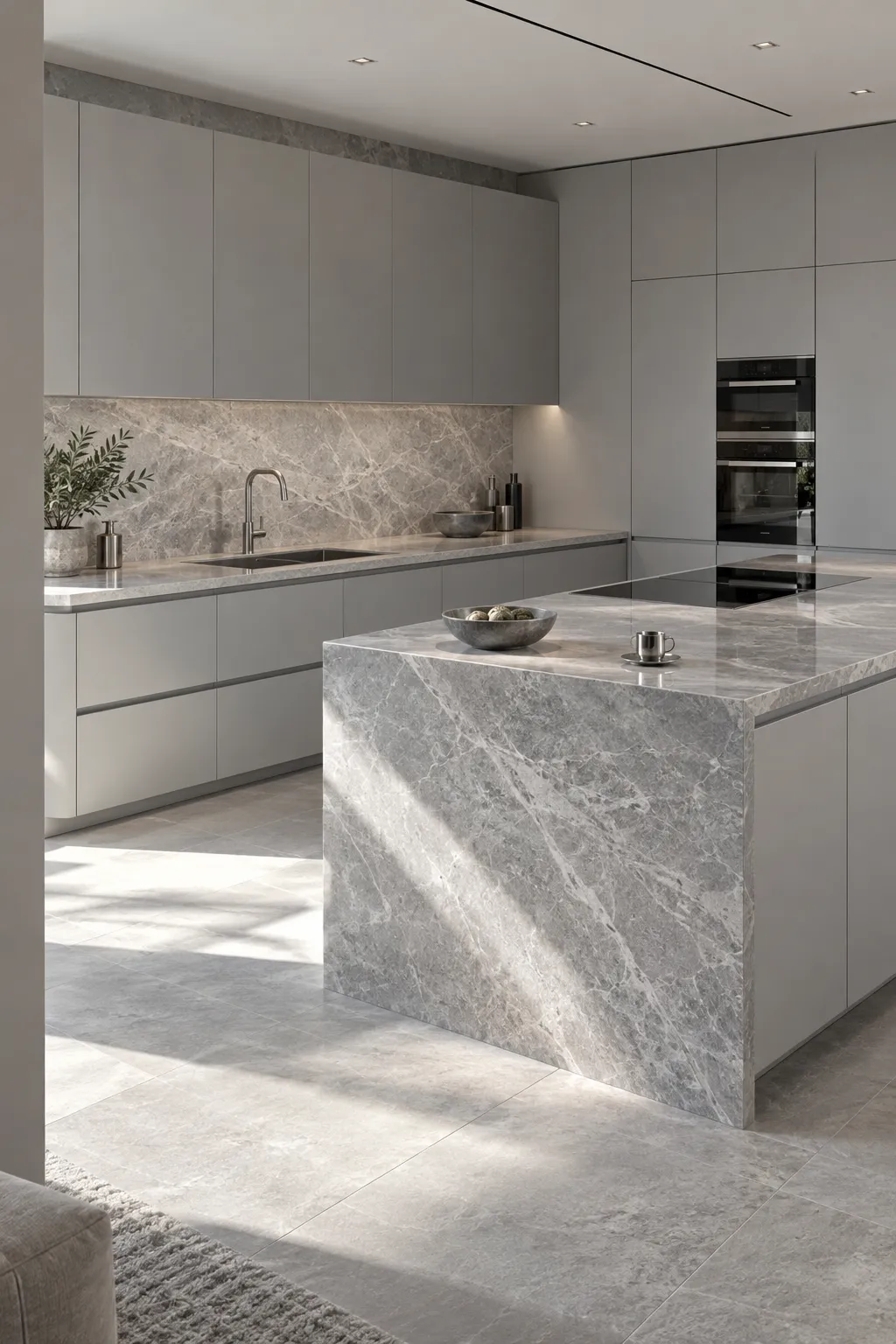
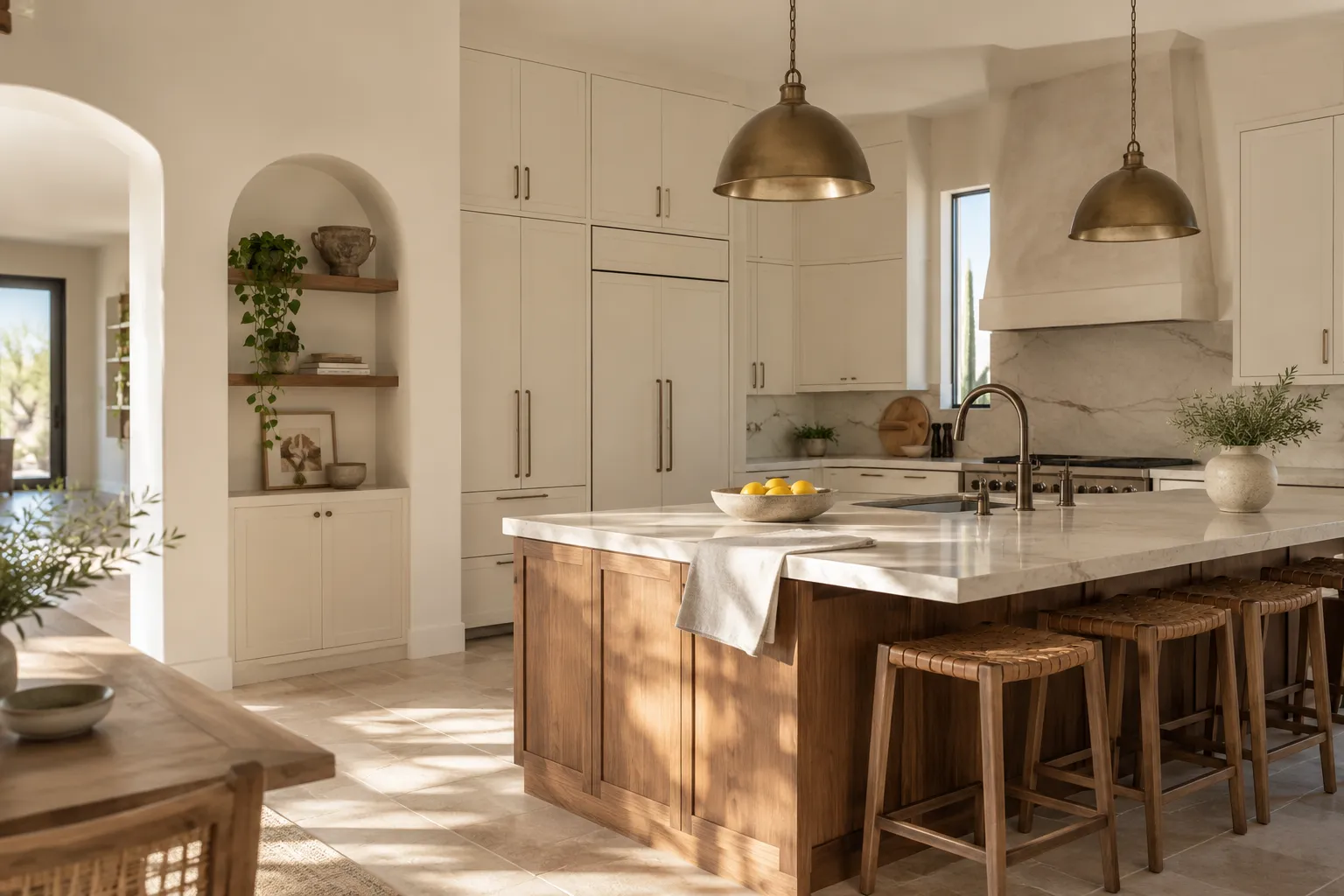
What it is: a large format porcelain slab, usually 12 mm or 2 cm, printed to read as stone. Daltile's own guidance says a 12 mm slab needs a mitered edge to look like a 2 cm or 3 cm countertop.
Fits: a slim, modern waterfall where the leg reads as a thin plane, and a house where nobody wants to seal anything.
Skip it if: you want a one off natural look up close, or the island has a long unsupported overhang.
The Arizona note: porcelain is light, and it handles a sunlit leg without colour shift. The risk is the edge, where a thin corner chips on a direct hit.
06Countertops
Sintered stone: the engineered answer to sun and heat
What it is: an ultracompact surface made from a mineral mix, pressed and sintered. Dekton is the best known, with Neolith in the same family.
Fits: an island that takes real abuse and real sun. The maker describes Dekton as resistant to stains, scratches, knocks, high temperatures and UV, with almost zero porosity.
Skip it if: you want visible variation from slab to slab, or need to match natural stone elsewhere in the room.
The Arizona note: the most forgiving surface for a west facing leg in July, which is why it shows up on Scottsdale patios as well as kitchens.
07Countertops
Quartz: the practical pick with one condition
What it is: engineered stone, ground quartz bound in resin and pressed into slabs. Nonporous, consistent, easy to live with indoors.
Fits: an island that never sees direct sun, in a house that wants zero sealing and a tight, even look.
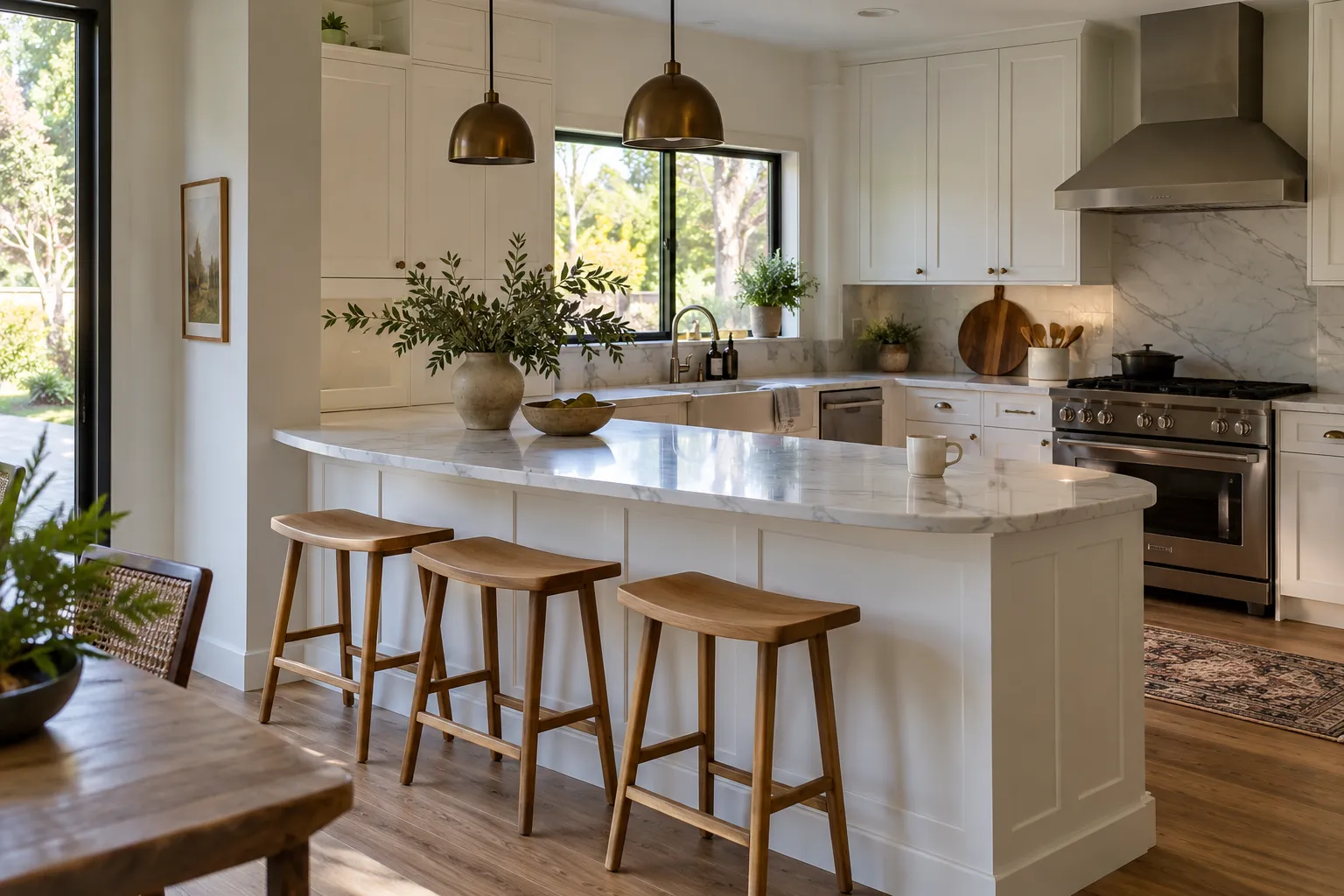
Skip it if: the leg faces a window that gets afternoon sun. Quartz makers say use trivets and use high and low pH chemicals with caution, and outdoor quartz is sold as a separate product line.
The Arizona note: a quartz top in a north facing kitchen is sensible. The same slab on a west facing leg in an unshaded house is the wrong application, and it fails as a colour shift rather than a crack.
08Planning
What the rest of the room decides
Two local facts narrow the choice. Scottsdale water runs 16 to 18 grains per gallon north of Chaparral, 20 to 22 between Indian School and Chaparral, and 22 to 25 south of Indian School Road, so the further south the house, the more mineral spotting every surface takes. And Phoenix has averaged 111 days a year at or above 100 F since the 1990s, which is what a west facing leg sits in.
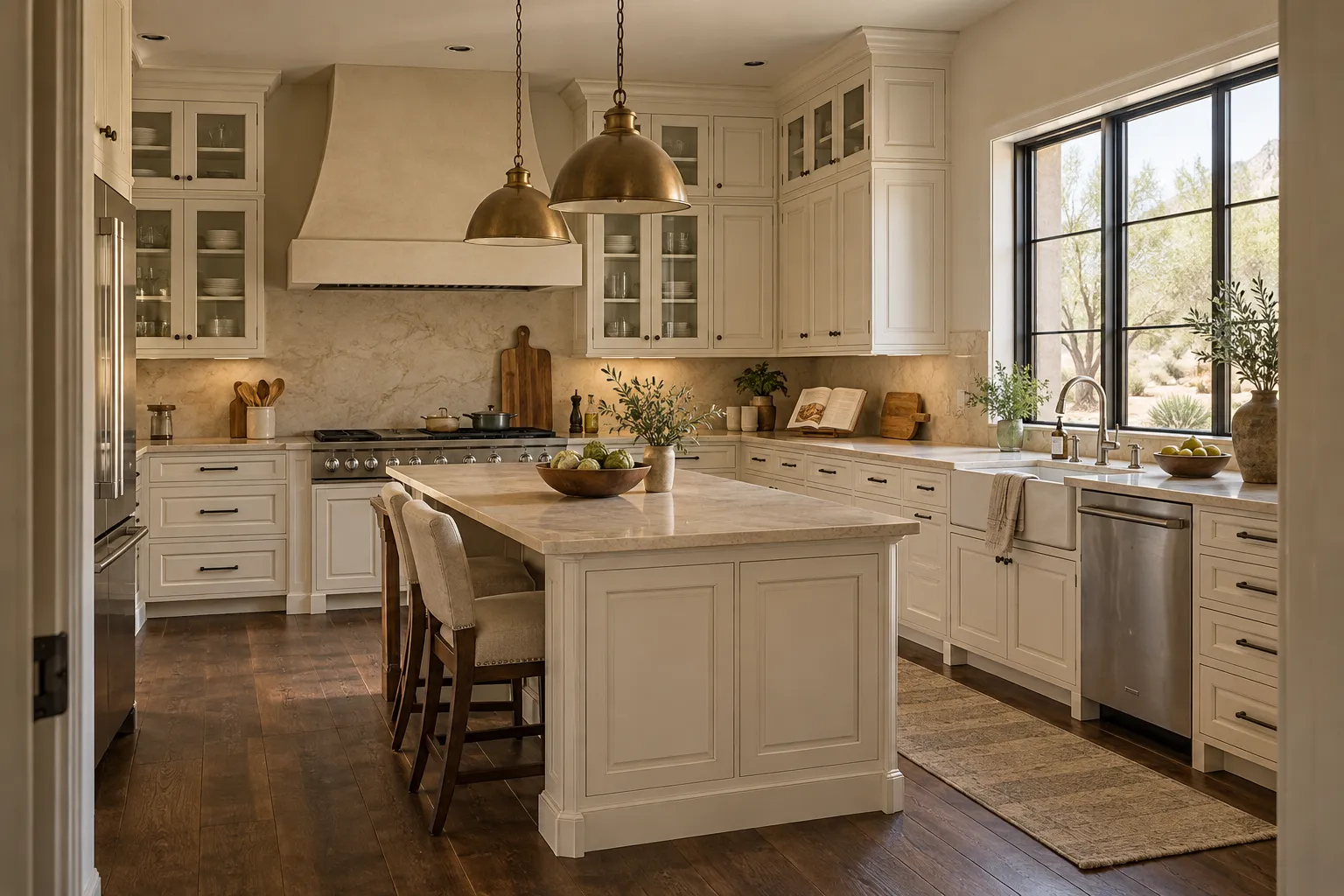
The layout matters too, and the island page covers seating, size and storage before the material question. Seating puts hands against the leg, a prep sink puts water on top, and a cooktop puts heat on it. The countertop page covers edges, templating and installation for the rest of the room. A local contractor checks the slab flatness where the leg lands, the sun path at the hour the kitchen is used, and whether the overhang needs support. The Italian kitchen guide shows where each of these stones belongs, and the durability comparison covers etching and sealing.
Call (480) 672-2248 and describe the island you want, or send the form, and someone from our team will call you back to go through the layout, the slab and the joint.
093 questions
Questions people ask about waterfall islands
Still have a question? Call (480) 672-2248 and describe the kitchen.
01Can any stone be made into a waterfall?
Most can be, but not every slab should be. Fissures, voids and inconsistent thickness are reasons to reject a slab for a mitered edge, even when the surface looks perfect.
02Do the legs match the top?
Only if they come from the same bundle. Bookmatched pairs are cut from adjacent slabs, and legs bought later may not match.
03How thick should a waterfall edge be?
2 cm and 3 cm are both common. A 3 cm slab gives more material at the miter and reads heavier; a 2 cm slab with a build up reads slimmer. For 12 mm porcelain, an edge build up is required to reach counter thickness.
10Sources
Sources
- Daltile, Panoramic Porcelain Surfaces (thickness, mitered edge, sealing)
- Cosentino, Dekton maintenance (heat, UV, porosity)
- Caesarstone, quartz care and heat guidance
- Caesarstone, outdoor product guidance
- US Natural Stone, The Definitive Guide to Quartzite (opens in a new tab)
- City of Scottsdale, Hard Water Facts (opens in a new tab)
- KJZZ, Phoenix days at 100 F (opens in a new tab)
Last checked: November 2026